Punarvasu is the 7th of the 27 nakshatras, spanning the last third of Gemini into the opening sliver of Cancer. Its name combines punah (“again”) and vasu (“light,” “wealth,” or “excellence”), and is usually translated as “the return of the light” or “restored wealth” — an older name, Yamakau, means “the two chariots,” echoing the nakshatra’s marker stars, Castor and Pollux, the bright twins of Gemini. Ruled by Jupiter and presided over by Aditi, mother of the gods, Punarvasu is consistently described as the nakshatra of recovery: whatever has been lost, scattered, or sent away eventually finds its way back.
Punarvasu at a glance
|
Attribute |
Detail |
|
Span |
20°00′ Gemini – 3°20′ Cancer |
|
Ruling planet (lord) |
Jupiter |
|
Deity |
Aditi, mother of the gods |
|
Symbol |
A bow and quiver of arrows |
|
Animal symbol |
Female cat |
|
Gana |
Deva |
|
Marker stars |
Castor and Pollux |
|
Older alternate name |
Yamakau (“the two chariots”) |
The deity: Aditi, the boundless mother
Aditi is one of the oldest and most expansive figures in the Vedic pantheon — her name means “boundless” or “unbound,” and she is honoured as the mother of the Adityas, the twelve solar gods. Where many nakshatra deities govern a specific force or domain, Aditi’s role is closer to an encompassing one: she represents the space within which everything else can exist, grow, and, when needed, be restored. That expansiveness is exactly why Punarvasu’s core theme is recovery rather than loss — Aditi’s boundlessness means there’s always room for something to come back.
The symbol: a quiver built to be refilled
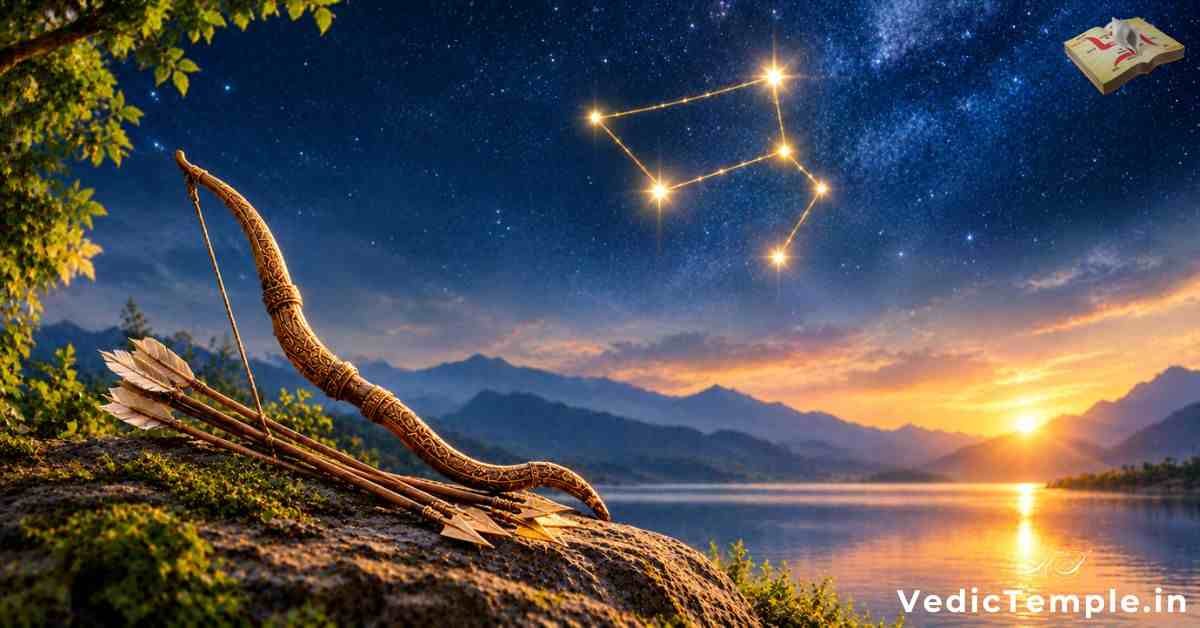
A bow and a quiver of arrows is Punarvasu’s primary symbol, and the detail that matters is the quiver specifically: an arrow leaves it, but the quiver itself is designed to be refilled, not emptied once and discarded. Read this way, the symbol isn’t really about the arrow in flight — it’s about the capacity to keep sending things out and keep receiving them back, over and over, without running dry.
The Rama connection
Punarvasu carries one of the best-documented mythological connections of any nakshatra: Rama, the central figure of the Ramayana, is traditionally held to have been born with the Moon in this exact nakshatra — a detail recorded directly in the Ramayana itself, which describes the specific planetary configuration at his birth. The connection runs deeper than a birth detail. Rama’s own story is a near-perfect match for Punarvasu’s theme: exile from his kingdom, years of wandering, and an eventual, triumphant return to Ayodhya — a return still celebrated today as Diwali, the festival of lights, in one of that festival’s best-known mythological associations. “Punarvasu” literally means “the return of the light,” which makes the Diwali connection feel less like a coincidence and more like the nakshatra’s meaning playing out on a civilisational scale.
A recurring motif: divine twins
Punarvasu’s marker stars, Castor and Pollux, are themselves twins in Greek mythology, and “twinness” shows up as a recurring motif wherever this nakshatra is discussed — not as a strict one-to-one equivalence across traditions, but as the same basic pattern (a paired, complementary set of figures) appearing independently in several mythologies: Castor and Pollux in Greek myth, Romulus and Remus in Roman myth, and, fittingly, Rama’s own twin sons Luv and Kush later in the Ramayana. None of this means these figures are literally “the same” as each other — it’s simply a motif worth noticing, the way this nakshatra’s own name and symbolism keep circling back to the idea of a pair, a return, and something completing itself.
Personality traits
Sources consistently describe Punarvasu natives as warm, nurturing, and genuinely optimistic — people who tend to give others a second chance rather than hold a grudge, and who recover from setbacks with real resilience rather than lingering bitterness. A simple, unpretentious way of approaching complicated situations is frequently cited too, often illustrated by Rama’s own famously direct, uncomplicated sense of duty. The nakshatra’s deva gana and overall gentle reputation mean the traits usually discussed here lean favourable, though the same give-everyone-another-chance quality can occasionally mean being too quick to re-extend trust that hasn’t been earned back.
Career and professional tendencies
- Teaching, counselling, and mentoring — roles built around nurturing growth and giving people room to improve
- Any work involving renewal, restoration or recovery, literally or figuratively — rehabilitation, conservation, repair trades
- Travel, aviation, or delivery-related work, drawing on the bow-and-arrow symbolism of sending something out and bringing it back
- Writing, storytelling, or work connected to tradition and heritage, reflecting Aditi’s broad, foundational role
The four padas
Punarvasu’s four padas each span 3°20′. The first three fall within the closing stretch of Gemini and the last within the opening sliver of Cancer, so earlier-pada natives carry more of Gemini’s communicative, adaptable quality, while the final pada carries Cancer’s nurturing, emotionally attuned quality — both consistent with Punarvasu’s overall theme of care and restoration, just inflected differently.
Frequently asked questions
What does Punarvasu mean?
“The return of the light” or “restored wealth,” from punah (again) and vasu (light/wealth). An older name, Yamakau, means “the two chariots,” reflecting the nakshatra’s twin marker stars, Castor and Pollux.
Which planet rules Punarvasu nakshatra?
Jupiter is the ruling planet (nakshatra lord) of Punarvasu.
Who is Aditi, the deity of Punarvasu nakshatra?
Aditi is an ancient Vedic goddess whose name means “boundless,” honoured as the mother of the twelve Aditya solar gods. She represents the open, unbounded space within which things can grow and be restored.
Is it true that Rama was born in Punarvasu nakshatra?
Yes — this is recorded directly in the Ramayana, which describes the specific planetary configuration at Rama’s birth. His own story of exile and triumphant return closely mirrors Punarvasu’s core theme of recovery and restoration.
What is the symbol of Punarvasu nakshatra?
A bow and a quiver of arrows — specifically emphasising the quiver’s capacity to be refilled, not just the arrow that leaves it.
What gana is Punarvasu nakshatra?
Deva gana.