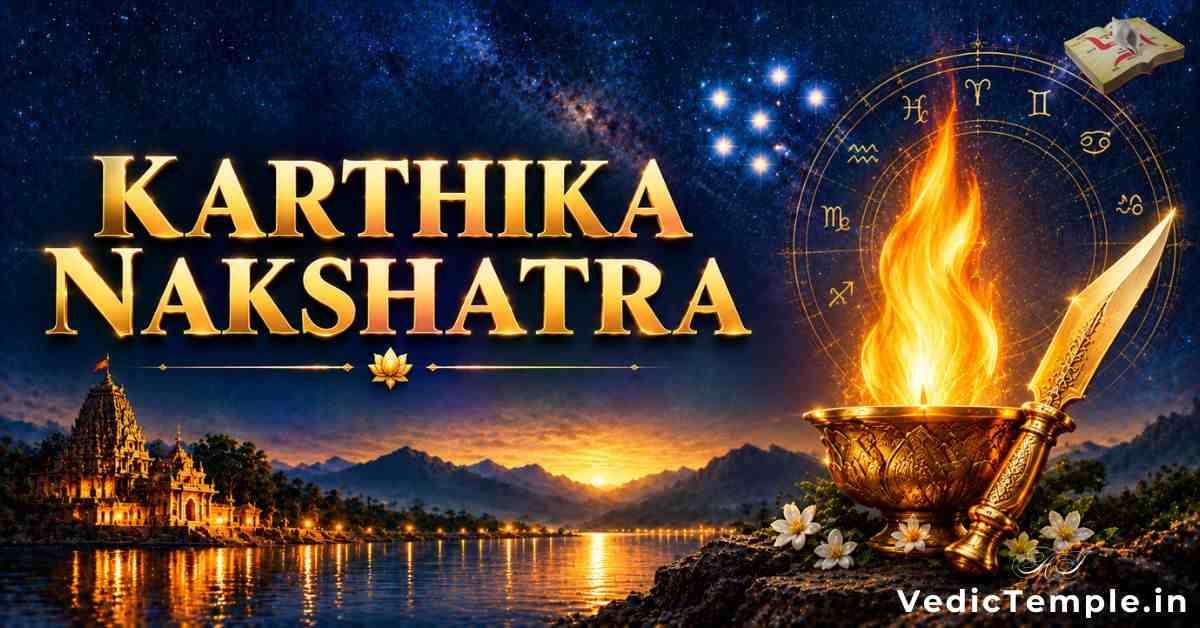
Karthika is the Tamil, Telugu and Malayalam name for Krittika, the 3rd of the 27 nakshatras, spanning the last third of Aries into the first third of Taurus. It takes its name from the Krittikas — the six stars of the Pleiades star cluster, personified in Hindu mythology as six mother-goddesses — and the nakshatra’s name means “the cutter,” pointing to sharpness, precision, and the ability to burn away what no longer serves a purpose. Karthika is also, simply, a very common South Indian given name; this page is specifically about the nakshatra, not the name.
Karthika at a glance
|
Attribute |
Detail |
|
Sanskrit / pan-Indian name |
Krittika |
|
Span |
26°40′ Aries – 10°00′ Taurus |
|
Ruling planet (lord) |
Sun |
|
Deity |
Agni, god of fire |
|
Symbol |
A razor or flame; a cooking pot / fire-hearth is also cited |
|
Gana |
Rakshasa |
|
Star cluster |
The Pleiades |
The Krittikas: six mothers, one star cluster
In Hindu mythology, the Krittikas are six stars of the Pleiades personified as six mother-goddesses who became the foster mothers of Kartikeya (also called Skanda or Murugan), the war-god son of Shiva. The story varies by source, but the core of it is consistent: Kartikeya’s essence, too powerful for a single mother to bear, was divided and nurtured by the six Krittikas, who raised him into the commander of the celestial armies — and his very name, Kartikeya, literally means “son of the Krittikas.” This is the single most important piece of context for understanding Karthika nakshatra: its deeper identity is bound up with motherhood, nurture, and the shaping of raw, powerful potential into disciplined strength, alongside the more commonly cited fire and sharpness themes.
Karthika Deepam: the festival this nakshatra is named for
Karthika nakshatra gives its name to one of South India’s major festivals. Karthika Deepam (also Karthikai Deepam) falls on the full moon of the Tamil month of Karthigai — timed to coincide with the Moon’s passage through this very nakshatra — and is celebrated across Tamil Nadu, Kerala and Sri Lanka with rows of oil lamps, commemorating Shiva’s manifestation as an infinite column of light (Jyotirlinga) and, in some traditions, the birth of Kartikeya himself. This is the clearest illustration of how directly this nakshatra’s mythology (fire, the Krittikas, Kartikeya) translates into living cultural practice, rather than staying confined to birth-chart interpretation.
The deity: Agni, god of fire
Agni governs purification, transformation, digestion and sacrifice — the fire that both destroys impurity and sustains life through the inner heat of digestion and metabolism. Through Agni, Karthika natives are traditionally read as carrying determination, directness and the courage to confront things honestly, alongside a sharper edge: the same fire that purifies can also burn carelessly if left unchecked.
The symbol: razor, flame, and cooking pot
The razor or blade represents clarity and the ability to cut cleanly through illusion or deception; the flame represents purification and transformation more broadly; a cooking pot or hearth, cited by some sources as a third symbol, represents fire in its nurturing form — the same element that destroys also feeds and sustains. Read together, the three symbols map directly onto the nakshatra’s dual character: destructive and nourishing fire, held in the same hands.
Personality traits
Sources consistently describe Karthika natives as sharp-minded, direct, and naturally charismatic — people who tend to stand out and lead within a group rather than blend into it. Courage and a strong sense of right and wrong are frequently cited, alongside real determination once a goal is set. The honesty traditionally associated with this nakshatra is often described as blunt: Karthika natives are said to say what they mean, sometimes at the cost of tact, which is read as the sharper edge of the same razor-like clarity that otherwise serves them well.
Career and professional tendencies
- Leadership roles, especially ones that reward decisiveness and a willingness to confront problems directly
- Any field connected to fire, heat, or transformation in a literal sense — cooking, metallurgy, energy, and related trades
- Protective or martial roles, reflecting the Kartikeya/Skanda connection to military command
- Work involving sharp analysis or cutting through complexity — critique, investigation, editing, or any role that rewards clarity over diplomacy
A note on naming syllables
If you’re looking for Karthika’s traditional pada-based naming syllables specifically, be aware that this is one nakshatra where published sources genuinely disagree — not just on transliteration, but on the actual letters listed, with some sources giving four syllables and others giving as many as nine for the same four padas. Rather than publish a specific list here that can’t be confidently verified, this is a case where checking directly with your family’s own regional tradition, or a trusted local priest, is more reliable than any single online source, including this one.
Frequently asked questions
Is Karthika the same as Krittika nakshatra?
Yes — Karthika is the Tamil, Telugu and Malayalam name for the same nakshatra that Sanskrit and Hindi sources call Krittika.
What does the name Karthika mean?
It traces to the Krittikas, the six stars of the Pleiades personified as foster mothers of the god Kartikeya. The word itself is usually translated as “the cutter,” pointing to sharpness and precision.
Which planet rules Karthika nakshatra?
The Sun is the ruling planet (nakshatra lord) of Karthika.
What is the connection between Karthika nakshatra and Karthika Deepam?
Karthika Deepam, the South Indian festival of lamps, is timed to the full moon in this exact nakshatra, in the Tamil month named for it (Karthigai). The festival commemorates Shiva’s Jyotirlinga manifestation and, in some traditions, the birth of Kartikeya.
Who is the deity of Karthika nakshatra?
Agni, the god of fire, who governs purification, transformation and digestion.
What gana is Karthika nakshatra?
Rakshasa gana.