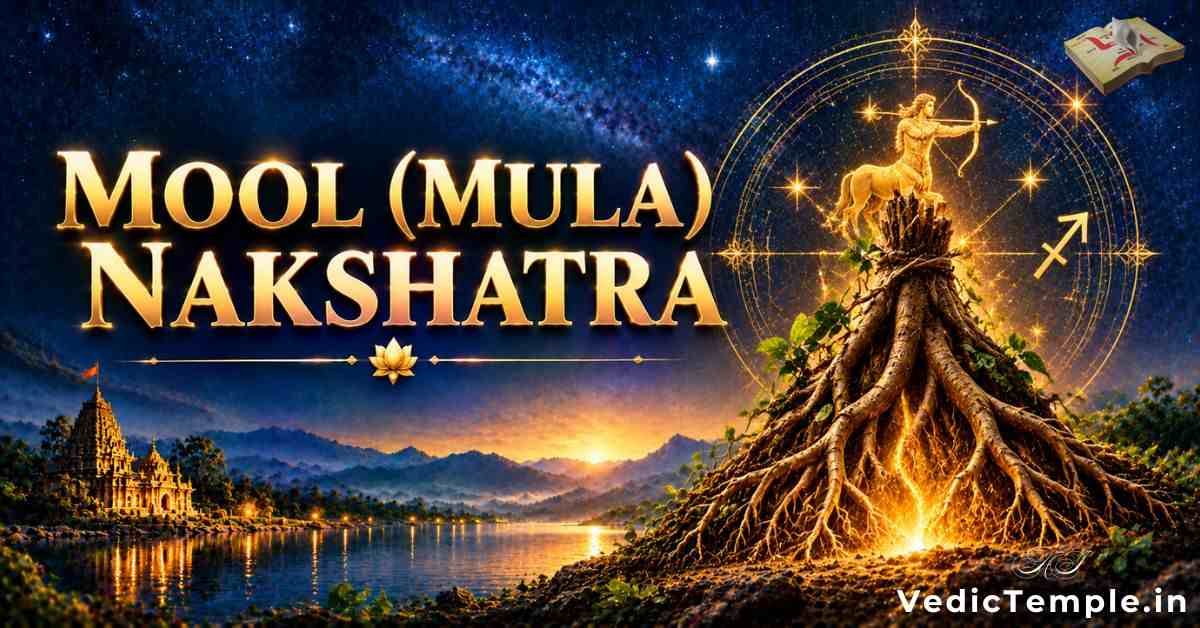
“Mool” is simply the common Hindi spelling and pronunciation of Mula, the 19th of the 27 nakshatras, spanning the opening 13°20′ of Sagittarius. Its name means “the root,” and it is consistently described across sources as the most intense and probing nakshatra in the entire sequence — the one concerned with digging past the surface of anything, including itself, until it reaches whatever is actually true underneath. Ruled by Ketu and presided over by Nirriti, goddess of dissolution, Mool/Mula is a nakshatra built around getting to the bottom of things, whatever that costs.
Mool (Mula) at a glance
|
Attribute |
Detail |
|
Span |
0°00′ – 13°20′ Sagittarius |
|
Ruling planet (lord) |
Ketu |
|
Deity |
Nirriti, goddess of dissolution |
|
Symbol |
A bunch of roots tied together; also cited: an elephant goad (ankusha) |
|
Gana |
Rakshasa |
|
Nature |
Tikshna (sharp) |
|
Special classification |
A Gandmoola nakshatra (see below) |
The deity: Nirriti, who unbinds rather than destroys outright
Nirriti is one of the older and less commonly discussed figures in the Vedic pantheon, associated with dissolution, calamity and the direction south or southwest — traditionally linked to the realm of the ancestors and the dead. It would be easy to read her as purely destructive, but most sources are careful to frame her role more precisely: Nirriti loosens and unties what has become fixed, rather than simply breaking it. In older Vedic hymn traditions, she’s associated with releasing people from binding entanglements — debts, old patterns, things that have outlived their purpose — which is a meaningfully different role from destruction for its own sake. That distinction matters for understanding Mool/Mula: this nakshatra’s intensity is in service of release, not chaos.
The symbol: tied roots, and what they’re tied for
A bunch of roots tied together is Mool’s primary symbol — the part of a plant that lives underground, unseen, holding everything visible up. The image works on two levels at once: roots represent foundation and origin, the true base of a matter, while being tied together suggests something gathered, examined, or pulled up deliberately rather than left buried. An elephant goad (ankusha) is sometimes cited as a secondary symbol, representing the same idea from a different angle — a tool specifically for directing great, otherwise unmanageable power.
A genuine astronomical coincidence worth knowing
One detail is worth mentioning because it’s actually true, not just poetic: the real centre of our Milky Way galaxy (the region around the radio source Sagittarius A*) sits, from Earth’s perspective, almost exactly where Mool/Mula nakshatra is located in the sky — right around the Sagittarius–Scorpius border. Several sources lean on this as a striking, if coincidental, reinforcement of the nakshatra’s reputation as the point closest to the deepest root of everything, cosmically as well as symbolically.
Personality traits
Sources consistently describe Mool/Mula natives as intense, investigative, and unflinching — the person who keeps asking “but why” past the point where most people stop, and who would rather confront an uncomfortable truth than maintain a comfortable illusion. A genuine pull toward research, philosophy, or anything involving getting to the root cause of a problem is frequently cited, alongside real courage under pressure. The caution that comes up just as often: this same relentlessness can read as destabilising to people or situations that depend on things staying unexamined, and Mool natives are sometimes described as leaving disruption in their wake even when their underlying intent was clarity, not harm.
Career and professional tendencies
- Research, investigation, and any field built on uncovering root causes rather than managing symptoms
- Philosophy, spirituality, and deep inquiry into fundamental questions
- Medicine or healing fields that work by addressing underlying causes directly, including surgery
- Occult or esoteric study, reflecting Ketu’s rulership and Nirriti’s association with what lies beneath the visible
Love and relationships
In relationships, Mool/Mula’s instinct to get to the root of things doesn’t switch off — natives are typically described as wanting real honesty rather than surface harmony, and as uncomfortable with a partner who avoids difficult conversations. This can build unusually deep trust with a partner who values the same directness, and real friction with one who prefers to let some things stay unexamined.
Mool (Mula) and Gandmoola
Mool/Mula is one of six Gandmoola nakshatras — the three that open a fire sign (Mula opening Sagittarius, Ashwini opening Aries, Magha opening Leo) and the three that close out the water sign immediately before it (Jyeshtha closing Scorpio, Ashlesha closing Cancer, Revati closing Pisces). A child born with the Moon in Mool/Mula, particularly its opening stretch, is traditionally given a Gandmoola Shanti ritual shortly after birth — the same common, traditional practice described in detail on our Ashlesha nakshatra page. (Despite the shared sound, “Gandmoola” isn’t specifically named after this nakshatra — moola simply means “root” or “base” in Sanskrit, and the classification term uses that general word, not a reference to Mula nakshatra in particular.) The ritual is not a sign of anything being wrong with the child, and is worth discussing with a family priest or astrologer rather than treating any single online description as the final word.
The four padas
Mool/Mula’s four padas each span 3°20′ and fall entirely within Sagittarius, so the sign’s searching, philosophical quality runs through all four; the shift across padas is generally read as a matter of navamsa-sign nuance within that shared theme rather than a change in core character.
Frequently asked questions
Is Mool the same as Mula nakshatra?
Yes — “Mool” is simply the common Hindi spelling and pronunciation of the same nakshatra Sanskrit sources write as Mula.
What does Mula mean?
“The root” — pointing to origin, foundation, and the practice of digging down to what’s actually true at the base of a matter.
मूल नक्षत्र के स्वामी ग्रह कौन हैं? (Which planet rules Mool nakshatra?)
मूल नक्षत्र का स्वामी ग्रह केतु है, और इसकी अधिष्ठात्री देवी निऋति हैं। (Mool nakshatra’s ruling planet is Ketu, and its presiding deity is Nirriti.)
Who is Nirriti, the deity of Mool nakshatra?
Nirriti is a Vedic goddess associated with dissolution and the loosening of what has become fixed — released from binding entanglements rather than simply destroying them outright.
Is Mool a Gandmoola nakshatra?
Yes — it is one of six nakshatras sitting at a sign-element junction (here, the start of Sagittarius, a fire sign, right after Jyeshtha closes out Scorpio, a water sign). A child born there, especially in its opening stretch, traditionally receives a Gandmoola Shanti ritual shortly after birth — a common practice, not a cause for concern.
What careers suit Mool nakshatra natives?
Research, investigation, philosophy, and healing fields that address root causes directly are the most consistently cited fits.