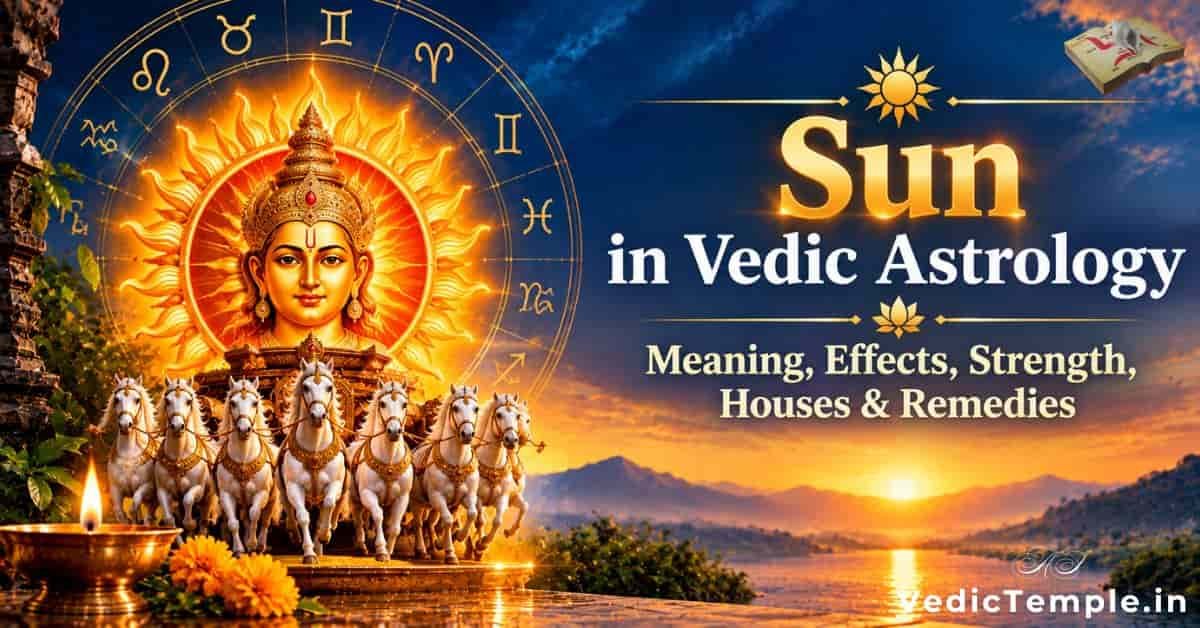
In Vedic astrology, the Sun (Surya) represents important themes such as the self, vitality, authority, father, leadership, recognition and one's sense of purpose. In a Kundli, however, the Sun should not be interpreted from its sign alone. Its house, sign, lordship, dignity, aspects, conjunctions, Nakshatra and Dasha all influence how its symbolism is expressed.
The Sun rules Leo (Simha Rashi), is traditionally exalted in Aries (Mesha) and debilitated in Libra (Tula). These are important technical factors, but they do not by themselves determine whether a person's entire horoscope is favourable or unfavourable.
What Is the Sun in Vedic Astrology?
The Sun is called Surya in Sanskrit and is one of the nine Navagrahas used in traditional Jyotisha.
In Vedic astrology, Surya is associated with the principle of individuality, authority, and vitality. Traditional astrological texts and modern Jyotisha practice also connect the Sun with the father, government, leadership, reputation, and one's capacity to exercise responsibility.
The Sanskrit term Graha does not correspond exactly to the modern astronomical meaning of “planet.” In Jyotisha, the Navagraha includes the Sun and Moon along with the visible planets and the lunar nodes.
The Sun is therefore interpreted as a symbolic graha within the astrological framework rather than as a physical planet in the modern astronomical sense. VedicTemple.in's broader guide to the Navagraha similarly distinguishes the traditional astrological use of “Graha” from modern astronomy.
What Does Surya Represent in a Kundli?
The Sun is traditionally associated with:
-
Self and individuality
-
Vitality
-
Authority
-
Leadership
-
Father and paternal figures
-
Government and administration
-
Reputation and recognition
-
Confidence and dignity
-
Responsibility
-
Purpose and direction
These significations are traditionally interpreted through the complete horoscope rather than through the Sun alone.
For example, Sun in a particular house may highlight authority or recognition in that area of life, but the result can change according to the Ascendant, house lordship, planetary associations and Dasha.
This is why a statement such as “a strong Sun always makes someone successful” is too simplistic for serious Kundli interpretation.
Sun's Important Astrological Characteristics
| Factor | Traditional association |
|---|---|
| Sanskrit name | Surya |
| Common name | Sun |
| Zodiac sign ruled | Leo (Simha) |
| Exaltation sign | Aries (Mesha) |
| Debilitation sign | Libra (Tula) |
| Moolatrikona | Leo, traditionally 0°–20° |
| Day | Sunday (Ravivar) |
| Natural nature | Krura / natural malefic |
| Vimshottari Mahadasha | 6 years |
| Aspect | 7th from its position |
The exact assessment of planetary strength requires more than these basic classifications. Dignity is one factor among several used in Jyotisha.
Sun in Leo: Its Own Sign
The Sun rules Leo (Simha), so Sun placed in Leo is in its own sign.
Traditionally, the first 20 degrees of Leo are also described as the Sun's Moolatrikona zone, while Leo is its own sign more generally. Moolatrikona and own sign should not be treated as synonyms, because they are distinct classifications.
Sun in Leo can emphasize themes traditionally associated with:
-
Self-definition
-
Leadership
-
Authority
-
Creativity
-
Responsibility
-
Recognition
-
Personal dignity
However, the house occupied by Leo and the condition of the Sun remain important.
Sun Exalted in Aries
The Sun is traditionally exalted in Aries (Mesha), with its deepest exaltation point at 10° Aries.
Exaltation is a technical dignity in Jyotisha. It does not mean that every person with an Aries Sun will automatically become successful, wealthy or powerful.
The complete chart must still be considered.
Sun Debilitated in Libra
The Sun is traditionally debilitated in Libra (Tula), with its deepest debilitation point at 10° Libra.
Debilitation should not be interpreted as a permanent verdict about a person's character or life.
Astrologers may examine additional factors such as the house, aspects, conjunctions, dispositor, divisional charts and possible cancellation of debilitation before drawing a conclusion.
Therefore, “Sun in Libra means failure” would be an unnecessarily simplistic interpretation.
Sun in the 12 Houses
The house occupied by the Sun shows the life area in which solar themes such as identity, authority, responsibility and recognition are traditionally emphasized.
Sun in the 1st House
The Sun in the first house can strongly emphasize identity, confidence, individuality and visibility.
Traditional interpretations may associate this placement with a strong desire to establish one's identity and take responsibility.
The final result depends on the Ascendant, Sun's condition and other chart factors.
Sun in the 2nd House
The second house relates traditionally to speech, family, accumulated resources and values.
Sun here may bring greater emphasis to family authority, speech, financial responsibility or personal values.
Its effect on wealth should not be judged from this placement alone.
Sun in the 3rd House
The third house is associated with courage, initiative, communication, skills and younger siblings.
Sun here may emphasize independence, initiative and the desire to take charge of one's efforts.
Sun in the 4th House
The fourth house relates to home, emotional foundations, mother, property and inner security.
Sun here can bring greater attention to authority within the home, property matters or questions of independence.
The relationship between the Sun and the fourth-house significations should be assessed from the complete chart.
Sun in the 5th House
The fifth house is traditionally connected with intelligence, creativity, children, learning, mantra and past-life merit.
Sun here may emphasize creativity, recognition, learning and leadership in intellectual or creative activities.
Sun in the 6th House
The sixth house relates to service, competition, debts, disease and disputes.
A Sun placed here may emphasize responsibility, competition and the need to deal directly with challenges.
A single placement should not be used to make medical predictions.
Sun in the 7th House
The seventh house concerns marriage, partnerships, public dealings and one-to-one relationships.
Sun here may make independence and authority important themes in partnerships.
The quality of marriage cannot be determined from Sun in the seventh house alone.
Sun in the 8th House
The eighth house is associated with transformation, inheritance, hidden matters, vulnerability and longevity.
Sun here can bring greater focus toward transformation, shared resources and deeper subjects.
Interpretation requires particular care because the eighth house has several distinct significations.
Sun in the 9th House
The ninth house is traditionally connected with dharma, higher learning, teachers, father, philosophy and long-distance journeys.
Sun here may emphasize principles, higher knowledge, leadership and questions of purpose.
Sun in the 10th House
The tenth house relates strongly to career, public reputation, authority and professional responsibilities.
Sun here can place considerable emphasis on leadership, visibility and achievement through responsibility.
The Sun is also traditionally associated with directional strength (Dig Bala) in the 10th house.
Sun in the 11th House
The eleventh house concerns gains, networks, aspirations and fulfilment of desires.
Sun here may emphasize recognition through networks, leadership within groups and achievement of long-term objectives.
Sun in the 12th House
The twelfth house is traditionally associated with expenditure, retreat, foreign places, isolation and spiritual release.
Sun here may direct attention toward private development, foreign connections, expenditure or spiritual themes depending on the complete horoscope.
Sun in the 12 Zodiac Signs
The Sun expresses differently according to the sign it occupies.
| Sun Sign | Traditional theme to examine |
|---|---|
| Aries | Initiative, independence and direct action |
| Taurus | Stability, resources and values |
| Gemini | Communication, learning and adaptability |
| Cancer | Emotional foundations and protection |
| Leo | Identity, leadership and self-expression |
| Virgo | Service, analysis and practical responsibility |
| Libra | Partnership, balance and negotiation |
| Scorpio | Depth, transformation and control |
| Sagittarius | Beliefs, learning and principles |
| Capricorn | Responsibility, structure and ambition |
| Aquarius | Groups, systems and social ideals |
| Pisces | Spirituality, imagination and compassion |
A Sun-sign interpretation remains incomplete without considering the house and Ascendant.
Sun's Aspect in Vedic Astrology
In the standard Parashari approach, the Sun casts a full 7th aspect (Drishti) from its position.
For example, if the Sun occupies the 3rd house, its seventh aspect falls on the 9th house.
This does not mean that the Sun always aspects the horoscope's seventh house. It aspects the seventh position counted from wherever the Sun is placed.
Sun and Nakshatras
The Sun can occupy any of the Nakshatras according to its exact sidereal longitude.
Three Nakshatras are traditionally ruled by the Sun in the Vimshottari system:
-
Krittika
-
Uttara Phalguni
-
Uttara Ashadha
The Sun's Nakshatra can add another interpretive layer to a Kundli. Its effects should be considered alongside the Nakshatra's lord, house, sign, pada and other chart factors.
Strong Sun and Weak Sun in Vedic Astrology
Astrologers may assess the Sun's condition through several factors rather than relying on one label.
These can include:
-
Sign dignity
-
House placement
-
House lordship
-
Aspects
-
Conjunctions
-
Dispositor
-
Nakshatra
-
Divisional charts
-
Shadbala or other strength calculations
-
Dasha
-
Relevant yogas
A traditionally well-supported Sun may be interpreted through qualities such as confidence, responsibility, leadership and clarity of purpose.
A challenged Sun may instead be interpreted through themes involving recognition, authority, confidence or relationships with father figures.
These are astrological interpretations, not scientifically established predictions about personality or life outcomes.
What Is Combustion of a Planet by the Sun?
In Jyotisha, combustion (Asta) refers to a planet being sufficiently close to the Sun that traditional astrology considers its visibility or ability to produce results affected.
Importantly, the Sun itself is not described as “combust.”
Different planets have different traditional combustion thresholds, so the exact calculation should be based on the planet involved rather than a single universal distance.
This is also why saying that every planet close to the Sun is automatically “bad” is an oversimplification.
Sun Mahadasha
In the Vimshottari Dasha system, the Sun's Mahadasha lasts 6 years.
During Sun Mahadasha, astrologers traditionally examine the natal Sun and its:
-
House placement
-
Sign
-
Lordship
-
Dignity
-
Nakshatra
-
Conjunctions
-
Aspects
-
Divisional-chart position
-
Antardasha
-
Relevant transits
Therefore, Sun Mahadasha does not produce one identical result for everyone.
Sun, Career and Authority
Surya is traditionally associated with authority, government, leadership, administration and public standing.
A prominent Sun may therefore become relevant when interpreting careers involving:
-
Administration
-
Government
-
Leadership
-
Management
-
Authority
-
Public responsibility
-
Institutional roles
But career outcomes require analysis of the 10th house, 10th lord, Sun, Saturn, Mercury, Jupiter, relevant Dashas and other chart factors, depending on the astrological system being used.
Traditional Remedies for the Sun
Traditional Surya remedies vary between lineages and practices. They should be understood as religious or astrological practices, not guaranteed methods for changing life outcomes.
Commonly discussed practices include:
Offering Arghya to the Sun
Offering water to the rising Sun is a traditional Surya practice.
The exact procedure can vary according to family and regional tradition.
Surya Namaskar
Surya Namaskar is traditionally associated with reverence toward the Sun and is also practiced as a sequence of physical yoga postures.
It should not be presented as a guaranteed astrological remedy.
Surya Mantra
Traditional Sun mantras are used in Surya worship and Japa practices.
Because mantra wording and transliteration can vary, the exact mantra should be verified before publication rather than copied from an unverified website.
Sunday Worship
Sunday, Ravivar, is traditionally associated with Surya.
Some practitioners therefore choose Sunday for Surya-oriented devotional practices.
Aditya Hridayam
Aditya Hridayam is a well-known Sanskrit hymn associated with the worship of Surya and is traditionally found in the Ramayana tradition.
Its use should be described as devotional practice rather than as a guaranteed solution to a particular worldly problem.
Should You Wear Ruby for a Weak Sun?
Ruby (Manikya) is traditionally associated with the Sun.
However, recommending a gemstone solely because the Sun appears weak is an incomplete astrological approach.
In Jyotisha, gemstone recommendations can depend on the Ascendant, house lordship, planetary relationships, dignity and overall chart.
Therefore, a generic statement such as “everyone with a weak Sun should wear Ruby” should be avoided.
Common Mistakes When Reading the Sun
1. Looking only at the Sun sign
The Sun sign is only one part of the Kundli.
2. Calling Sun in Leo “exalted”
The Sun is in its own sign in Leo. Its traditional exaltation is in Aries.
3. Treating debilitation as a life verdict
A debilitated Sun does not automatically mean failure or lack of confidence.
4. Ignoring house lordship
The same Sun can operate differently for different Ascendants because its functional role changes with house ownership.
5. Making health predictions from one placement
Astrological interpretation should not be presented as medical diagnosis or scientific certainty.
6. Promising results from remedies
Traditional remedies can be explained respectfully without guaranteeing wealth, health, career success, marriage or other outcomes.
Frequently Asked Questions
What does the Sun represent in Vedic astrology?
The Sun (Surya) is traditionally associated with the self, vitality, authority, father, leadership, government, dignity and recognition.
Which sign is ruled by the Sun?
The Sun rules Leo (Simha Rashi) in traditional Vedic astrology.
Where is the Sun exalted?
The Sun is traditionally exalted in Aries (Mesha), with its deepest exaltation point at 10° Aries.
Where is the Sun debilitated?
The Sun is traditionally debilitated in Libra (Tula), with its deepest debilitation point at 10° Libra.
Is Sun in Leo exalted?
No. Sun in Leo is in its own sign, and traditionally its Moolatrikona extends through the first 20 degrees of Leo. Exaltation is in Aries.
Which house is associated with the Sun's directional strength?
The Sun is traditionally associated with Dig Bala in the 10th house.
How long is Sun Mahadasha?
In the Vimshottari Dasha system, Sun Mahadasha lasts 6 years.
Is a weak Sun always bad?
No. “Weak” can refer to different technical conditions, and the overall interpretation depends on the complete horoscope. Astrologers may examine dignity, house, lordship, aspects, conjunctions, divisional charts and Dasha before reaching a conclusion.
What is the traditional remedy for the Sun?
Traditional practices include Surya worship, offering Arghya, Sunday devotional practices, Surya-related mantra Japa and other practices depending on one's tradition. These should be understood as traditional spiritual practices rather than guaranteed outcomes.
The Sun in Vedic astrology is much more than a simple indicator of confidence or personality. Surya is traditionally associated with the self, vitality, father, authority, leadership, recognition and purpose.
Its interpretation becomes meaningful only when its sign, house, lordship, dignity, aspects, conjunctions, Nakshatra and Dasha are considered together.
The most important principle is therefore simple: do not judge a Kundli from the Sun alone. A complete Vedic astrology interpretation requires the Sun to be understood within the structure of the entire birth chart.