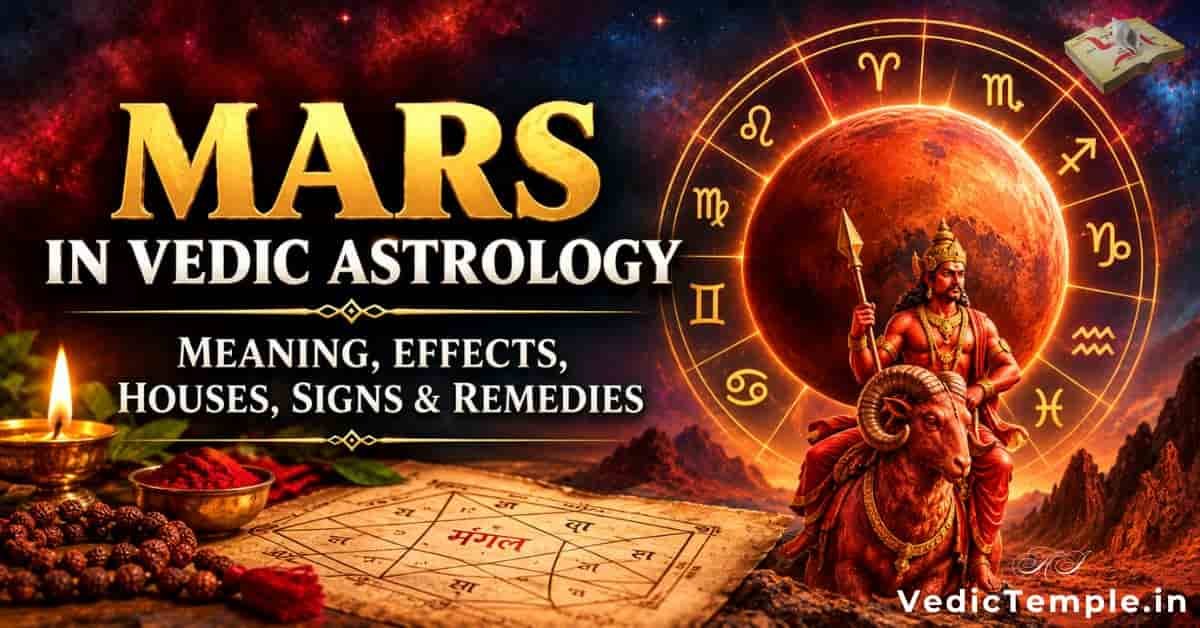
Mars (Maṅgal) in Vedic Astrology: Meaning, Effects, Houses, Signs & Remedies
Mars (Mangal or Mangala) is one of the most important Grahas in Vedic astrology for understanding courage, initiative, physical drive, competition, land, younger siblings and the way a person takes action.
In Jyotisha, Mars is traditionally classified as a natural malefic (Krura Graha), but this does not mean that Mars is always harmful. Its force can express as courage, discipline, technical ability and determination, or as conflict and impulsive action, depending on its condition in the birth chart.
Mars rules Aries (Mesha) and Scorpio (Vrishchika), is traditionally exalted in Capricorn (Makara) and debilitated in Cancer (Karka). It also has special full aspects on the 4th, 7th and 8th houses from its position.
The most useful way to understand Mars is therefore not simply as the “planet of anger,” but as the astrological principle of directed force and action.
What Is Mars in Vedic Astrology?
Mars is called Mangal, Mangala, Kuja, Bhauma and Angaraka in different Sanskrit traditions.
In Jyotisha, Mars represents the capacity to act, compete, protect, build, separate and overcome resistance.
Its traditional significations include:
- Courage and initiative
- Physical energy
- Younger siblings
- Land and property
- Technical skills
- Competition
- Conflict
- Determination
- Weapons and tools
- Engineering and mechanical work
- Blood, muscles and physical force in traditional medical astrology
These significations should be understood within the traditional astrological framework rather than as scientifically established effects.
What Does Mars Represent in Vedic Astrology?
Mars is associated with Parakrama, commonly translated as courage, valor or the capacity to make an effort.
Its symbolism is therefore broader than anger or aggression.
| Mars Signification | Traditional Meaning |
|---|---|
| Courage | Ability to take initiative and face resistance |
| Energy | Physical drive and capacity for action |
| Younger siblings | Particularly younger brothers/siblings |
| Land | Property, construction and immovable assets |
| Competition | Fighting spirit and ability to compete |
| Technical ability | Engineering, mechanics and practical skills |
| Conflict | Arguments, disputes and confrontation |
| Protection | Defending oneself or others |
| Fire | Heat, intensity and force |
| Determination | Persistence in pursuing an objective |
Classical astrology also associates Mars with harsh or forceful activity. This is why the same planetary energy can be interpreted constructively in one horoscope and more challengingly in another.
Is Mars a Benefic or Malefic Planet?
Mars is traditionally classified as a natural malefic.
However, “malefic” does not mean “bad.”
In Jyotisha, natural malefic planets can produce useful results in appropriate circumstances. Mars gives the force needed to compete, take risks, protect boundaries and act decisively.
A disciplined Mars can therefore represent:
- Courage
- Persistence
- Leadership in action
- Competitive ability
- Technical skill
- Physical discipline
- Ability to confront obstacles
An afflicted or poorly directed Mars may traditionally be associated with:
- Impatience
- Anger
- Arguments
- Reckless action
- Conflict
- Excessive competitiveness
The actual interpretation depends on the Ascendant, house lordship, sign, dignity, aspects, conjunctions, planetary strength and Dasha.
Mars Owns Which Zodiac Signs?
Mars rules two signs:
- Aries (Mesha)
- Scorpio (Vrishchika)
Aries expresses Mars through direct action, initiative and outward assertion.
Scorpio expresses Mars through intensity, persistence, investigation and controlled force.
The same Mars therefore has different expressions depending on which of its signs is involved.
Where Is Mars Exalted?
Mars is traditionally exalted in Capricorn (Makara).
Its deepest exaltation point is generally given as 28° Capricorn.
Capricorn is ruled by Saturn and is associated with structure, responsibility, endurance and disciplined effort.
From a traditional astrological perspective, Mars's force can therefore operate through greater organization and persistence in Capricorn.
But exaltation alone does not determine the complete result.
The house occupied by Mars, its lordship, aspects, conjunctions, Nakshatra and overall strength must also be considered.
Where Is Mars Debilitated?
Mars is traditionally debilitated in Cancer (Karka), with 28° Cancer regarded as the deepest point of debilitation.
This placement is traditionally interpreted as a condition in which Mars's direct and forceful nature may operate through the emotional and protective symbolism associated with Cancer.
However, debilitated does not mean automatically disastrous.
Neecha Bhanga and other supporting factors can modify the result, and the complete horoscope must be examined before making a conclusion.
Mars's Special Aspects
One of Mars's distinctive features in Parashari-style Jyotisha is its special aspects.
Mars has full aspects on:
- 4th house from itself
- 7th house from itself
- 8th house from itself
Classical Phaladeepika explicitly describes Mars as having special aspects on the 4th and 8th in addition to the standard 7th aspect.
For example, if Mars is placed in the 1st house, its special aspects fall on the:
- 4th house
- 7th house
- 8th house
These aspects are important when interpreting Mars's influence on other houses.
Mars in the 12 Houses
Mars produces different traditional results depending on the Bhava it occupies.
Mars in the 1st House
Mars in the Ascendant can emphasize courage, initiative, competitiveness and physical drive.
The person may be more direct in dealing with situations and more willing to take action.
However, an afflicted Mars may traditionally indicate impatience or excessive impulsiveness.
Mars in the first house is also one of the placements considered in traditional Mangal Dosha calculations, although the complete Dosha assessment requires additional factors.
Mars in the 2nd House
The second house represents family, speech, food and accumulated wealth.
Mars here can make speech more direct or forceful and can connect financial decisions with initiative and risk-taking.
Traditional interpretations may also associate this placement with family disagreements or sharp speech when Mars is afflicted.
Mars in the 3rd House
The third house represents courage, initiative, communication, skills and younger siblings.
Mars has a strong natural affinity with these themes.
Classical Phaladeepika gives Mars in the third house favorable results involving courage and effort.
This placement is often discussed as one where Mars's capacity for action can express strongly.
Mars in the 4th House
The fourth house represents home, mother, property, vehicles and inner comfort.
Mars here can make property, construction or domestic matters more active.
If afflicted, traditional interpretations may emphasize domestic tension or disputes involving property.
The fourth house is also included in several traditional calculations of Mangal Dosha.
Mars in the 5th House
The fifth house represents intelligence, learning, creativity, children and past-life merit.
Mars here can produce an energetic and competitive approach to learning and creative expression.
Traditional texts may give mixed results depending on the complete planetary condition.
Mars in the 6th House
The sixth house represents competition, enemies, debts, service and obstacles.
Mars can function strongly in this environment because its competitive nature has a direct field of expression.
Classical Phaladeepika gives Mars in the sixth house notably favorable traditional results, including victory over opponents.
This does not mean that every person with Mars in the sixth house will automatically defeat every competitor. House lordship and other chart factors remain essential.
Mars in the 7th House
The seventh house represents marriage, partnerships, agreements and interaction with others.
Mars here can make relationships more passionate, active or competitive.
Traditional Mangal Dosha calculations commonly include the seventh house.
Therefore, Mars in the seventh should not be interpreted as an automatic indication of marriage failure. The condition of Venus, the seventh lord, Jupiter, Navamsa and relevant Dashas must also be examined.
Mars in the 8th House
The eighth house represents transformation, hidden matters, sudden developments, inheritance and vulnerability.
Mars here can bring intensity to eighth-house themes.
Traditional texts can describe difficult results for Mars in the eighth house.
Such classical statements should be understood in their historical astrological context and should not be converted into guaranteed predictions about death, accidents or disease.
Mars in the 9th House
The ninth house represents Dharma, higher learning, teachers, fortune and long-distance journeys.
Mars can bring an active and independent approach to beliefs, education or long-term goals.
The final interpretation depends on the ninth lord, Jupiter, Mars's dignity and the overall horoscope.
Mars in the 10th House
The tenth house represents career, authority, action and public responsibilities.
Mars can be particularly significant here because the house concerns Karma, or action in the world.
Classical Phaladeepika gives Mars in the tenth house notable results involving authority and action.
Mars in the tenth may therefore be relevant when analyzing careers involving engineering, construction, defense, surgery, machinery, athletics, technical work or environments requiring decisive action.
The exact career result cannot be determined from Mars alone.
Mars in the 11th House
The eleventh house represents gains, networks, ambitions and fulfillment of desires.
Mars here can connect income and achievement with competition, initiative and sustained effort.
Classical Phaladeepika gives Mars in the eleventh house favorable traditional results involving wealth and happiness.
Mars in the 12th House
The twelfth house represents expenditure, retreat, foreign environments, isolation and loss.
Mars here may direct energy toward private activities, foreign environments or areas requiring expenditure and withdrawal.
Traditional interpretations can be challenging, but the complete horoscope is essential before reaching a conclusion.
Mars in the 12 Zodiac Signs
Mars behaves differently according to the sign it occupies.
| Mars Sign | General Traditional Interpretation |
|---|---|
| Aries | Direct, energetic and highly action-oriented |
| Taurus | Persistent, practical and determined |
| Gemini | Mentally active, communicative and tactical |
| Cancer | Traditionally debilitated; action may be strongly influenced by emotion |
| Leo | Assertive, expressive and leadership-oriented |
| Virgo | Technical, analytical and detail-focused |
| Libra | Action directed toward relationships, negotiation and balance |
| Scorpio | Intense, strategic and persistent; Mars's own sign |
| Sagittarius | Energetic pursuit of principles, learning and exploration |
| Capricorn | Disciplined and structured; Mars's exaltation sign |
| Aquarius | Independent, strategic and group-oriented |
| Pisces | Imaginative, compassionate and less directly forceful |
These are general sign-level interpretations, not complete predictions.
Mars's house, lordship, Nakshatra, aspects and planetary associations can significantly change the expression.
Mars and Nakshatras
Mars rules three of the 27 Nakshatras:
- Mrigashira
- Chitra
- Dhanishtha
These Nakshatras span different zodiac signs:
- Mrigashira — Taurus and Gemini
- Chitra — Virgo and Libra
- Dhanishtha — Capricorn and Aquarius
The Nakshatra occupied by Mars can add another layer to the interpretation of its energy and action.
It is therefore useful to examine Rashi + Bhava + Nakshatra together rather than relying only on the zodiac sign.
Mars Mahadasha
Mars has a 7-year Mahadasha in the Vimshottari Dasha system.
During Mars Mahadasha, traditional astrologers examine the natal condition of Mars to understand which areas of life may become more prominent.
Important factors include:
- Mars's house
- Mars's sign
- House lordship
- Nakshatra
- Aspects
- Conjunctions
- Yogas
- Divisional charts
- Antardasha
- Current transits
Therefore, Mars Mahadasha does not produce one identical result for everyone.
Mars and Career
Mars can be relevant to careers that require action, technical ability, courage, competition or physical discipline.
Traditional Mars-associated fields may include:
- Engineering
- Construction
- Architecture
- Military and defense
- Police and security
- Surgery
- Athletics
- Mechanical work
- Real estate
- Manufacturing
- Technical professions
Modern career decisions should not be made solely from one planetary placement.
For a proper career analysis, astrologers would normally consider the 10th house, 10th lord, Ascendant, Mars, Sun, Mercury, Saturn, Jupiter, Dashas and relevant divisional charts.
Mars and Land & Property
Mars is traditionally associated with land, property, construction and physical structures.
This is why Mars can be relevant when analyzing:
- Property acquisition
- Construction
- Real estate activity
- Land disputes
- Engineering
- Buildings and infrastructure
The fourth house and its lord remain particularly important when evaluating property matters.
Mars and Younger Siblings
Mars is traditionally connected with younger siblings, especially younger brothers in some classical interpretations.
The third house is also the primary house considered for siblings and courage.
Therefore, astrologers may examine:
- Mars
- Third house
- Third lord
- Planets occupying the third house
- Relevant aspects
A conclusion about sibling relationships should not be based on Mars alone.
What Is Mangal Dosha?
Mangal Dosha, also called Kuja Dosha or Manglik Dosha, is a traditional astrological concept associated with the placement of natal Mars in specified houses.
A commonly used house-based calculation considers Mars in the:
1st, 2nd, 4th, 7th, 8th or 12th houses.
However, traditions differ regarding the exact calculation, reference points and cancellation conditions. Some systems calculate it from the Ascendant, Moon and/or Venus.
Therefore, simply finding Mars in one of these houses is not enough to declare that a marriage will fail.
Mangal Dosha should be assessed along with:
- Mars's sign
- Mars's strength
- Aspects
- Conjunctions
- Seventh house
- Seventh lord
- Venus
- Jupiter
- Navamsa
- Both partners' charts
- Cancellation or mitigation conditions
VedicTemple.in's existing Mars content also discusses Mangal Dosha, making topical consolidation particularly important before publishing another dedicated page.
Is Mangal Dosha a Curse?
It is better to avoid describing Mangal Dosha as a curse.
Within traditional Jyotisha, it is an astrological condition used in certain approaches to marriage matching and relationship analysis.
It should not be presented as a guarantee of divorce, widowhood, domestic violence or marital failure.
This is particularly important for responsible astrology content because fear-based claims can cause unnecessary anxiety and lead people to make major personal decisions based on an oversimplified interpretation.
Strong Mars vs Afflicted Mars
A strong Mars and an afflicted Mars are not the same thing.
A well-supported Mars may traditionally express as:
- Courage
- Initiative
- Determination
- Physical discipline
- Competitive ability
- Technical skill
- Decisiveness
A heavily afflicted Mars may traditionally be associated with:
- Impatience
- Conflict
- Recklessness
- Harsh reactions
- Excessive competitiveness
- Difficulty controlling anger
But “strong Mars” does not automatically mean “good Mars.”
A very powerful Mars can also intensify difficult themes if it rules or occupies challenging houses.
The question is not simply whether Mars is strong.
The question is how that strength operates in the particular Kundli.
How to Judge Mars in a Kundli
A proper Mars analysis should follow several steps.
1. Check the Ascendant
Determine which houses Mars rules for the specific Lagna.
Mars can be functionally benefic, malefic or a mixed influence depending on the Ascendant.
2. Check the House
The Bhava occupied by Mars shows where its force is expressed.
3. Check the Sign
Determine whether Mars is in:
- Own sign
- Exaltation
- Debilitation
- Friendly sign
- Neutral sign
- Inimical sign
4. Check the Aspects
Mars's 4th, 7th and 8th aspects can influence other houses and planets.
5. Check Conjunctions
Mars combined with another Graha can substantially change its expression.
6. Check Nakshatra
The Nakshatra lord adds another layer to the interpretation.
7. Check Planetary Strength
Traditional Jyotisha uses several systems for assessing planetary strength, including Shadbala.
8. Check Dasha
Mars becomes particularly relevant during its Mahadasha or relevant Antardasha.
This approach is more reliable than declaring a result from “Mars in X sign” alone.
Traditional Remedies for Mars
Vedic astrology traditions prescribe several remedies for Mars.
Depending on the horoscope and tradition, these may include:
- Tuesday devotional practices
- Worship of Hanuman
- Worship associated with Kartikeya or Mangala
- Mars mantra
- Charity
- Disciplined physical activity
- Acts of service
- Traditional fasting practices
Remedies should be presented as traditional spiritual practices, not scientifically proven treatments or guaranteed methods for changing life outcomes.
Mars Mantra
A commonly used Mars mantra is:
Om Kraam Kreem Kraum Sah Bhaumaya Namah
It is traditionally associated with Mangala worship.
Mantra practice should be understood as a devotional or spiritual practice. It should not be presented as a scientifically proven treatment for anger, illness, accidents or other medical conditions.
Red Coral for Mars
Red Coral (Moonga) is traditionally associated with Mars.
However, wearing Red Coral should not automatically be recommended simply because Mars appears weak.
Gemstone suitability depends on the individual's:
- Ascendant
- Functional lordship of Mars
- House placement
- Sign dignity
- Aspects
- Conjunctions
- Overall planetary strength
- Dasha
A gemstone can therefore be discussed as a traditional Jyotisha recommendation, not as a guaranteed solution.
Is Mars Good for Career?
Mars can be helpful for careers requiring action, technical skill, courage and competition, but there is no single career that is automatically indicated by Mars alone.
For career analysis, examine the complete professional combination of:
10th house + 10th lord + Mars + Sun + Mercury + Saturn + Jupiter + Dasha + relevant divisional charts.
Mars becomes particularly relevant when technical ability, physical effort, competition or decisive action forms part of the profession.
Is Mars Good for Wealth?
Mars can have traditional connections with land, property, construction, technical work and entrepreneurial initiative.
But Mars alone cannot determine wealth.
For financial analysis, astrologers should consider the 2nd house, 11th house, their lords, Jupiter, Venus, relevant yogas and Dashas, along with Mars where appropriate.
Frequently Asked Questions About Mars in Vedic Astrology
What does Mars represent in Vedic astrology?
Mars traditionally represents courage, energy, initiative, competition, younger siblings, land, property, technical ability and forceful action.
Which signs does Mars rule?
Mars rules Aries (Mesha) and Scorpio (Vrishchika).
Where is Mars exalted?
Mars is traditionally exalted in Capricorn (Makara), with its deepest exaltation point at 28° Capricorn.
Where is Mars debilitated?
Mars is traditionally debilitated in Cancer (Karka), with its deepest debilitation point at 28° Cancer.
What are Mars's special aspects?
Mars has full aspects on the 4th, 7th and 8th houses from its position in the Parashari-style aspect system.
How long is Mars Mahadasha?
Mars Mahadasha lasts 7 years in the Vimshottari Dasha system.
Which Nakshatras are ruled by Mars?
Mars rules Mrigashira, Chitra and Dhanishtha.
Is Mars in the 7th house always bad for marriage?
No. Mars in the seventh house can be considered in Mangal Dosha analysis, but it does not by itself determine the outcome of a marriage. The seventh lord, Venus, Jupiter, Navamsa, Mars's condition and both partners' charts should be considered.
Is Mangal Dosha present only when Mars is weak?
No. Mangal Dosha and planetary strength are separate questions. A strong Mars can still occupy a house included in a particular Mangal Dosha calculation.
Is an exalted Mars always beneficial?
No. Exaltation indicates a particular form of planetary dignity, but the final result depends on house lordship, house placement, aspects, conjunctions, Dasha and the rest of the horoscope.
What is the traditional remedy for Mars?
Traditional remedies may include Tuesday worship, Hanuman or Kartikeya devotion, Mars mantra, charity and disciplined spiritual practices. The appropriate remedy depends on the complete horoscope.
Mars in Vedic astrology represents force directed toward action.
It is associated with courage, initiative, competition, younger siblings, land, property, technical ability and physical drive. As a natural malefic, Mars can create friction, but its energy can also support discipline, protection, courage and achievement.
Its effect cannot be judged from a single factor.
A meaningful Mars analysis considers the Ascendant, house, sign, lordship, dignity, aspects, conjunctions, Nakshatra, planetary strength and Dasha together.
Mangal Dosha should likewise be handled carefully. It is a traditional astrological framework, not a guaranteed prediction of marital failure.
The deeper lesson of Mars in Jyotisha is not simply anger versus peace. It is about how a person's force, courage and desire to act are directed.
A disciplined Mars can turn energy into purposeful action; an uncontrolled Mars can create unnecessary friction. The birth chart is traditionally used to understand that difference.
Note: The interpretations in this article describe traditional Vedic astrology/Jyotisha beliefs and methods. They are not scientifically established predictions and should not replace qualified medical, psychological, financial, legal or other professional advice.