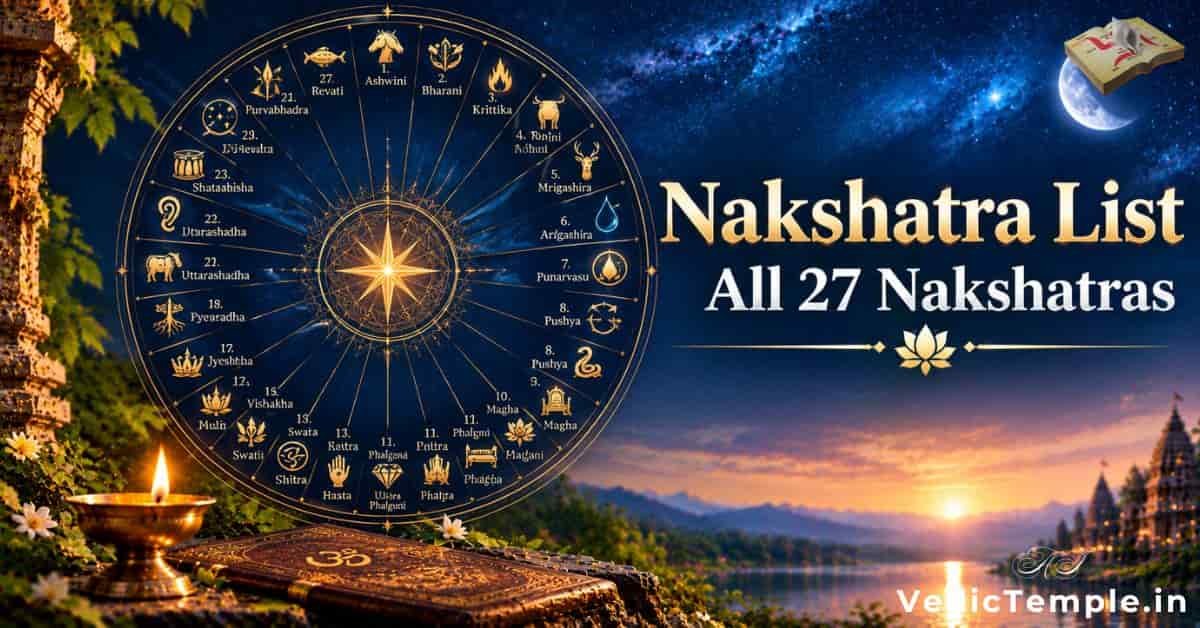
A nakshatra is one of 27 equal, 13°20′-wide divisions of the sky along the path the Moon travels, used in Vedic astrology to place the Moon’s position far more precisely than the twelve broader zodiac signs (rashis) alone. Each nakshatra carries its own ruling planet, presiding deity, symbol and temperament classification (gana). Your janma nakshatra — the one the Moon occupied at the moment you were born — is one of the 27 rows below.
All 27 nakshatras, in order
|
# |
Nakshatra |
Degrees (sidereal) |
Lord |
Deity |
Symbol |
Gana |
|
1 |
Ashwini |
00°00′–13°20′ Aries |
Ketu |
Ashwini Kumaras |
Horse’s head |
Deva |
|
2 |
Bharani |
13°20′–26°40′ Aries |
Venus |
Yama |
Yoni / womb |
Manushya |
|
3 |
Krittika |
26°40′ Aries–10°00′ Taurus |
Sun |
Agni |
Razor, flame |
Rakshasa |
|
4 |
Rohini |
10°00′–23°20′ Taurus |
Moon |
Brahma (Prajapati) |
Ox-cart, chariot |
Manushya |
|
5 |
Mrigashira |
23°20′ Taurus–06°40′ Gemini |
Mars |
Soma (Chandra) |
Deer’s head |
Deva |
|
6 |
Ardra |
06°40′–20°00′ Gemini |
Rahu |
Rudra |
Teardrop |
Manushya |
|
7 |
Punarvasu |
20°00′ Gemini–03°20′ Cancer |
Jupiter |
Aditi |
Bow and quiver |
Deva |
|
8 |
Pushya |
03°20′–16°40′ Cancer |
Saturn |
Brihaspati |
Cow’s udder, lotus |
Deva |
|
9 |
Ashlesha |
16°40′ Cancer–00°00′ Leo |
Mercury |
Nagas |
Coiled serpent |
Rakshasa |
|
10 |
Magha |
00°00′–13°20′ Leo |
Ketu |
Pitrs (ancestors) |
Royal throne |
Rakshasa |
|
11 |
Purva Phalguni |
13°20′–26°40′ Leo |
Venus |
Bhaga |
Front legs of a bed |
Manushya |
|
12 |
Uttara Phalguni |
26°40′ Leo–10°00′ Virgo |
Sun |
Aryaman |
Back legs of a bed |
Manushya |
|
13 |
Hasta |
10°00′–23°20′ Virgo |
Moon |
Savitar |
Hand, fist |
Deva |
|
14 |
Chitra |
23°20′ Virgo–06°40′ Libra |
Mars |
Tvashtar (Vishwakarma) |
Bright jewel |
Rakshasa |
|
15 |
Swati |
06°40′–20°00′ Libra |
Rahu |
Vayu |
Young shoot swaying |
Deva |
|
16 |
Vishakha |
20°00′ Libra–03°20′ Scorpio |
Jupiter |
Indra-Agni |
Triumphal arch |
Rakshasa |
|
17 |
Anuradha |
03°20′–16°40′ Scorpio |
Saturn |
Mitra |
Lotus |
Deva |
|
18 |
Jyeshtha |
16°40′ Scorpio–00°00′ Sagittarius |
Mercury |
Indra |
Umbrella, earring |
Rakshasa |
|
19 |
Mula |
00°00′–13°20′ Sagittarius |
Ketu |
Nirriti |
Bunch of roots |
Rakshasa |
|
20 |
Purva Ashadha |
13°20′–26°40′ Sagittarius |
Venus |
Apas (the Waters) |
Elephant tusk, fan |
Manushya |
|
21 |
Uttara Ashadha |
26°40′ Sagittarius–10°00′ Capricorn |
Sun |
Vishvedevas |
Elephant tusk |
Manushya |
|
22 |
Shravana |
10°00′–23°20′ Capricorn |
Moon |
Vishnu |
Ear, three footprints |
Deva |
|
23 |
Dhanishta |
23°20′ Capricorn–06°40′ Aquarius |
Mars |
Eight Vasus |
Drum |
Rakshasa |
|
24 |
Shatabhisha |
06°40′–20°00′ Aquarius |
Rahu |
Varuna |
Empty circle |
Rakshasa |
|
25 |
Purva Bhadrapada |
20°00′ Aquarius–03°20′ Pisces |
Jupiter |
Aja Ekapada |
Front of funeral cot |
Manushya |
|
26 |
Uttara Bhadrapada |
03°20′–16°40′ Pisces |
Saturn |
Ahirbudhnya |
Back of funeral cot |
Manushya |
|
27 |
Revati |
16°40′–30°00′ Pisces |
Mercury |
Pushan |
Fish, drum |
Deva |
Degrees are sidereal (the system Vedic astrology uses) and were calculated directly from first principles — 27 equal 13°20′ divisions starting at 0° Aries — rather than copied from a single source, then cross-checked against several independently published nakshatra references for agreement.
How the system actually works
The Moon takes roughly 27.3 days to complete one sidereal orbit — one full circuit of the ecliptic relative to the fixed stars. Dividing the 360° ecliptic into 27 equal segments of 13°20′ each gives one segment for roughly each day the Moon spends in a given stretch of sky, which is the basic logic behind the nakshatra system. Each nakshatra is further divided into four padas (quarters) of 3°20′ each, for 108 padas across the full zodiac — the same number, not coincidentally, that recurs throughout Hindu tradition (108 beads on a mala, for instance). Your janma nakshatra and pada together pin down the Moon’s position at birth far more precisely than a rashi (zodiac sign) alone, which is why nakshatra-level detail matters for things like naming conventions and detailed compatibility matching.
Why 27, and not 28?
This is a genuine historical wrinkle worth knowing. Because the Moon’s sidereal month is closer to 27.3 days than exactly 27, some of the oldest textual lists — including a hymn in the Atharvaveda — include a 28th nakshatra, Abhijit, inserted between Uttara Ashadha and Shravana. Classical and most modern practice settled on the 27-fold division for the equal-segment system used in horoscopy, leaving Abhijit as a historically attested but largely unused 28th station today. If you see a source mention 28 nakshatras, this is almost always why.
The three ganas, grouped
Gana groups each nakshatra by temperament, and is one of the eight factors (koota) checked in traditional Ashtakoot marriage matching. The 27 nakshatras split evenly, nine to a group.
|
Deva Gana (divine) |
Manushya Gana (human) |
Rakshasa Gana (intense) |
|
Ashwini, Mrigashira, Punarvasu, Pushya, Hasta, Swati, Anuradha, Shravana, Revati |
Bharani, Rohini, Ardra, Purva Phalguni, Uttara Phalguni, Purva Ashadha, Uttara Ashadha, Purva Bhadrapada, Uttara Bhadrapada |
Krittika, Ashlesha, Magha, Chitra, Vishakha, Jyeshtha, Mula, Dhanishta, Shatabhisha |
“Rakshasa” is often mistranslated in passing as simply “demonic,” which overstates it — within this specific classification it describes an intense, self-directed, less compromise-driven temperament, not a moral judgement. Chitra, the nakshatra traditionally associated with craftsmen, architects and artists, is Rakshasa gana; so is Magha, associated with authority and ancestral honour. The label describes energy, not character.
How to find your own nakshatra
Your janma nakshatra depends on exactly where the Moon was in the sky at the moment you were born, which moves roughly 13° per day — fast enough that an uncertain birth time can genuinely put you in the wrong nakshatra, even if it wouldn’t change your zodiac sign (rashi). An accurate birth date, time and place, run through proper sidereal astrological software (most tools default to the Lahiri ayanamsha), is the reliable way to find it. A rough birth time can get you the right rashi but the wrong nakshatra, so treat a nakshatra result with appropriate caution if your birth time isn’t well documented.
Nakshatras and rashis: how they overlap
Because each rashi (zodiac sign) spans 30° and each nakshatra spans 13°20′, they don’t line up one-to-one — most signs contain two full nakshatras plus part of a third. Aries, for instance, holds all of Ashwini and Bharani and the first part of Krittika; Krittika itself continues on into the beginning of Taurus. This is why two people with the same Moon sign (rashi) can have different nakshatras, and why nakshatra-level detail is treated as the more precise layer underneath the broader sign.
Frequently asked questions
How many nakshatras are there?
27 in standard practice, though some of the oldest classical lists include a 28th, Abhijit, between Uttara Ashadha and Shravana. Modern horoscopy almost universally uses the 27-fold system.
What is the difference between a nakshatra and a rashi?
A rashi is one of the 12, 30°-wide zodiac signs. A nakshatra is one of 27 narrower, 13°20′ divisions used specifically to place the Moon more precisely. Each rashi contains two full nakshatras plus part of a third.
How do I find my nakshatra?
You need an accurate birth date, time and place run through sidereal astrological software — the Moon moves quickly enough that an uncertain birth time can put you in the wrong nakshatra even when your zodiac sign is unaffected.
What is a pada?
Each nakshatra divides into four padas (quarters) of 3°20′ each, giving 108 padas across the full zodiac. Padas are used for finer detail in some traditions, including certain naming conventions.
What does gana mean in a nakshatra context?
Gana groups the 27 nakshatras into three temperament types — Deva, Manushya and Rakshasa, nine each — used as one of eight factors in traditional Ashtakoot marriage matching. “Rakshasa” describes intensity of temperament in this context, not a moral or demonic quality.
Which nakshatra is considered the most auspicious?
No single answer is universal across sources, but Rohini, Pushya, Hasta, Anuradha and Revati are commonly grouped together in some traditions as especially favourable, often referred to collectively in that context. Treat this as one strand of opinion within the tradition rather than a settled ranking.