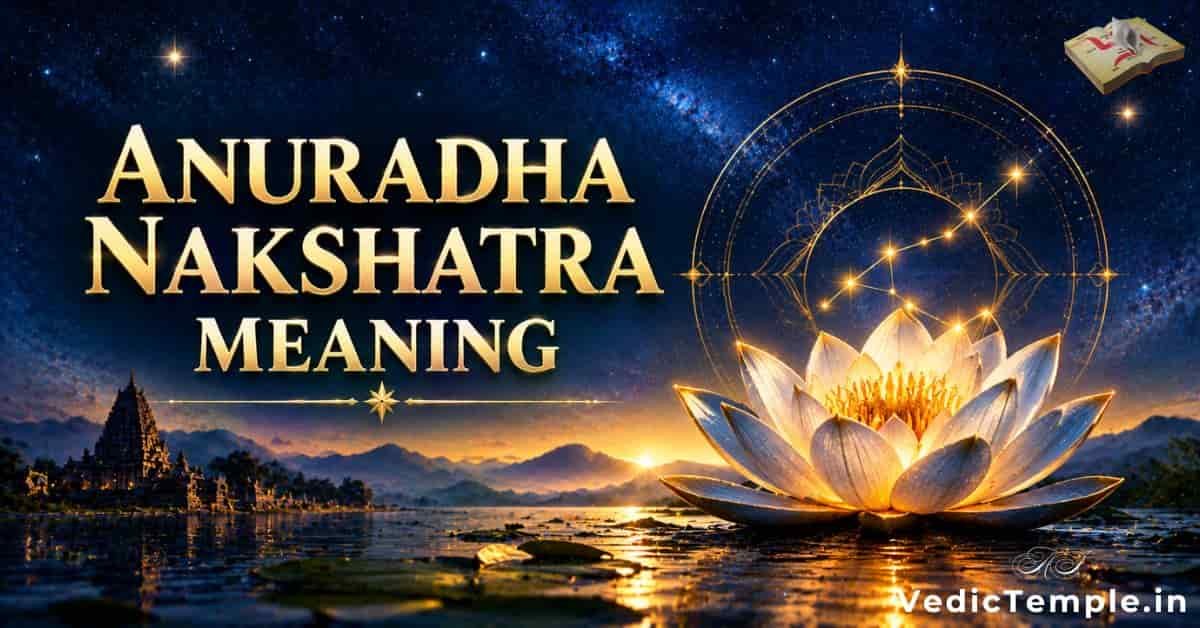
Anuradha is the 17th of the 27 nakshatras, spanning the middle third of Scorpio (3°20′ to 16°40′). Ruled by Saturn and presided over by Mitra, the Vedic deity of friendship and sacred contract, it is one of the tradition’s most consistently favourable nakshatras — associated across sources with loyalty, cooperation, discipline, and the steady work of building and honouring relationships, whether personal, professional, or spiritual.
Anuradha at a glance
|
Attribute |
Detail |
|
Span |
3°20′ – 16°40′ Scorpio |
|
Ruling planet (lord) |
Saturn |
|
Deity |
Mitra (Aditya of friendship and sacred contract) |
|
Symbol |
Lotus flower; also a triumphal archway, and sometimes a staff |
|
Gana |
Deva |
|
Nature |
Mridu (soft, gentle) |
|
Associated stars |
Beta, Delta and Pi Scorpii |
What the name means
Anuradha’s etymology carries two layers that most sources blend together without separating. The literal reading is “following Radha” — Radha here referring to the older name of the neighbouring nakshatra Vishakha, so Anuradha is, astronomically, simply “the one that follows.” A more popular, interpretive reading splits the word differently: anu (another, or following) plus a sense of “success” or “prosperity,” giving “success that follows success” — read as a nakshatra of achievement that builds steadily rather than arriving all at once. Both readings point toward the same practical theme: Anuradha is associated with things that develop in sequence and endure, rather than sudden fortune.
The deity: Mitra
Mitra is one of the Adityas — the twelve solar deities — and specifically governs friendship, partnership, contracts and cosmic order, frequently invoked alongside Varuna as the pair who together uphold cosmic law (Mitra-Varuna). Etymologically, “Mitra” traces to a Proto-Indo-Iranian root meaning “to bind,” the same root behind the Avestan deity Mithra in ancient Iranian religion and, through a separate line of cultural transmission, the Roman mystery cult of Mithras. The common thread across all three is the same: a sacred, binding agreement between parties, kept through honour rather than force. In Anuradha, this shows up as loyalty that holds a relationship together, and as the discipline to honour a commitment consistently rather than only when convenient.
The symbol: lotus and archway
Anuradha carries two commonly cited symbols that point toward complementary ideas. The lotus represents the capacity to rise clean and whole out of difficult circumstances — the flower’s traditional association with blooming untouched from muddy water. The triumphal archway or gateway represents successful passage: the completion of a shared journey or collaborative effort, often specifically read as a doorway reached together rather than alone. A staff is sometimes cited as a third, less common symbol, tied to the idea of clearing an obstacle from one’s path.
Personality traits
Sources consistently describe Anuradha natives as sociable, loyal, and unusually good at sustaining friendships and professional networks over long periods — less interested in a wide circle than a durable one. Saturn’s influence adds discipline and a certain seriousness about commitments: loyalty here is described less as blind attachment and more as a deliberate practice of honouring a bond consistently, even when it takes effort. A spiritual or devotional streak (bhakti) is frequently mentioned as well, alongside an interest in mysticism, intuition and occult subjects — Scorpio’s depth showing through Mitra’s more measured, relational focus.
Career and professional tendencies
- Diplomacy, negotiation, and any role built on maintaining long-term professional relationships
- Human resources, public relations and partnership-facing roles, where sustaining trust over time is the job itself
- Organising and leading groups or communities, drawing on both Mitra’s cooperative theme and Saturn’s structural discipline
- Counselling and advisory roles, where loyalty and discretion matter as much as expertise
- Research into spiritual, mystical or occult subjects, reflecting Scorpio’s underlying depth
Love, friendship and relationships
This is the area most sources dwell on, and for good reason: Anuradha’s whole character is built around Mitra’s theme of sustained, honoured partnership. Natives are typically described as deeply loyal partners and friends who invest real effort in making relationships last, with Saturn’s discipline showing up as a willingness to work through difficulty rather than walk away from it. The caution worth naming: because loyalty is so central to this nakshatra’s self-image, a broken trust or an ended relationship can land harder here than it might for a more detached nakshatra. As with any nakshatra-level description, this describes a tendency within a larger chart, not a fixed prediction about any individual relationship.
The four padas
Anuradha’s four padas each span 3°20′ and fall entirely within Scorpio, so the sign’s intensity and depth run through all four; the shift across padas is generally read as a matter of navamsa-sign nuance within that shared theme rather than a change in core character. Traditional naming conventions assign the syllables Na, Ni, Nu and Ne to the four padas respectively, used in some communities for choosing a child’s first name based on birth nakshatra and pada.
Frequently asked questions
What does Anuradha mean?
Literally “following Radha” (the older name of the neighbouring nakshatra Vishakha), and more loosely interpreted as “success that follows success” — achievement that builds steadily rather than arriving suddenly.
Which planet rules Anuradha nakshatra?
Saturn is the ruling planet (nakshatra lord) of Anuradha.
Who is Mitra, the deity of Anuradha?
Mitra is one of the twelve Adityas, governing friendship, partnership and sacred contract — often paired with Varuna as the upholders of cosmic law. The name shares a root with the ancient Iranian deity Mithra and, through a separate historical path, the Roman cult of Mithras.
Is Anuradha a good nakshatra?
Yes — it is consistently described across sources as one of the more favourable nakshatras, associated with loyalty, cooperation and steady achievement, and classified as Deva gana.
What careers suit Anuradha nakshatra natives?
Diplomacy, HR and partnership-facing roles, group leadership, counselling, and research into spiritual or mystical subjects are commonly cited.
What is the symbol of Anuradha nakshatra?
Most commonly a lotus flower (rising clean from difficult circumstances) and a triumphal archway (successful passage reached together); a staff is sometimes cited as a secondary symbol.