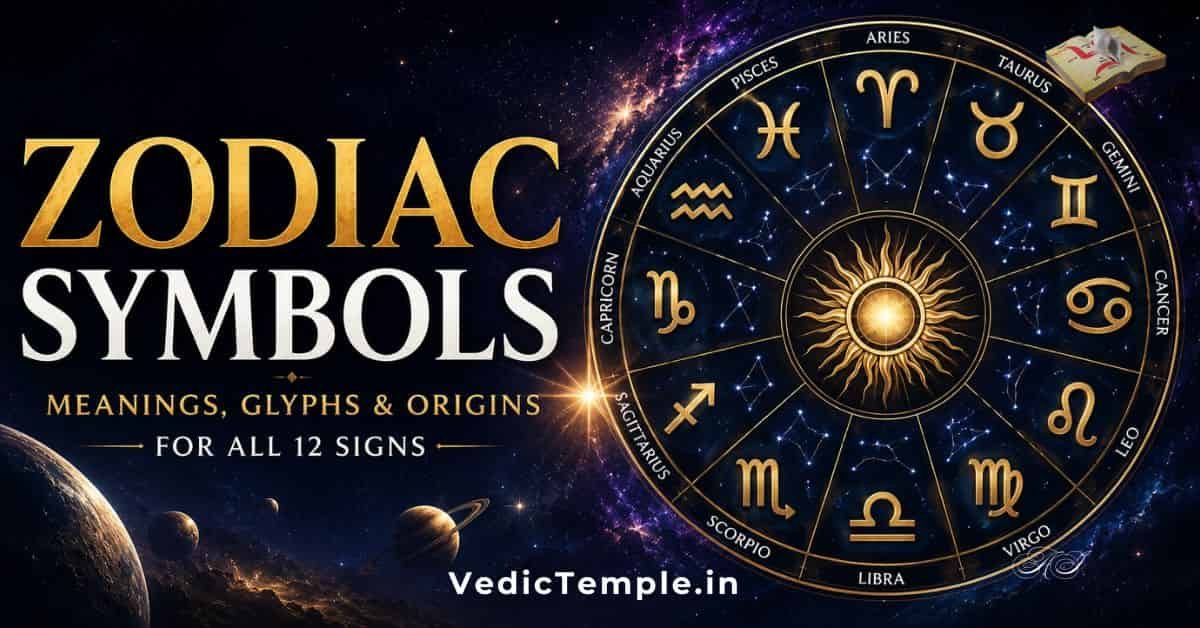
Every zodiac sign has two visual identities: an animal or figure (like the Ram or the Scales) and a glyph — the simplified symbol used in birth charts and horoscope apps. The 12 zodiac symbols are Aries (Ram), Taurus (Bull), Gemini (Twins), Cancer (Crab), Leo (Lion), Virgo (Maiden), Libra (Scales), Scorpio (Scorpion), Sagittarius (Archer), Capricorn (Sea-Goat), Aquarius (Water-Bearer), and Pisces (Fish). Each glyph is a stripped-down drawing of that figure, and each carries its own mythology, ruling planet, and element. Here's what every symbol looks like, what it means, and where it comes from.
Zodiac Symbols Quick-Reference Chart
Use this chart to see all 12 zodiac symbols, their glyphs, date ranges, elements, and ruling planets at a glance.
|
Sign |
Symbol |
Glyph |
Dates |
Element |
Modality |
Ruling Planet |
|
Aries |
Ram |
♈ |
Mar 21 – Apr 19 |
Fire |
Cardinal |
Mars |
|
Taurus |
Bull |
♉ |
Apr 20 – May 20 |
Earth |
Fixed |
Venus |
|
Gemini |
Twins |
♊ |
May 21 – Jun 20 |
Air |
Mutable |
Mercury |
|
Cancer |
Crab |
♋ |
Jun 21 – Jul 22 |
Water |
Cardinal |
Moon |
|
Leo |
Lion |
♌ |
Jul 23 – Aug 22 |
Fire |
Fixed |
Sun |
|
Virgo |
Maiden |
♍ |
Aug 23 – Sep 22 |
Earth |
Mutable |
Mercury |
|
Libra |
Scales |
♎ |
Sep 23 – Oct 22 |
Air |
Cardinal |
Venus |
|
Scorpio |
Scorpion |
♏ |
Oct 23 – Nov 21 |
Water |
Fixed |
Pluto (Mars) |
|
Sagittarius |
Archer |
♐ |
Nov 22 – Dec 21 |
Fire |
Mutable |
Jupiter |
|
Capricorn |
Sea-Goat |
♑ |
Dec 22 – Jan 19 |
Earth |
Cardinal |
Saturn |
|
Aquarius |
Water-Bearer |
♒ |
Jan 20 – Feb 18 |
Air |
Fixed |
Uranus (Saturn) |
|
Pisces |
Fish |
♓ |
Feb 19 – Mar 20 |
Water |
Mutable |
Neptune (Jupiter) |
What Are Zodiac Symbols, Exactly?
"Zodiac symbol" gets used two ways, and it helps to separate them. The first is the figure or mascot associated with a sign — an animal, a person, or an object, like the Bull for Taurus or the Scales for Libra. The second is the glyph: a simplified line drawing of that figure, used to save space on birth charts, horoscope calendars, and astrology software. When you see a small squiggle next to a planet symbol on a natal chart, that's the glyph, not the full figure.
The word "zodiac" itself comes from a Greek term meaning roughly "circle of animals," a nod to how many of the 12 signs are represented by creatures. Ancient astronomers split the band of sky the sun appears to travel through into 12 equal sections, matched each one to a constellation, and attached a story to explain how that constellation got there. Those stories are why the symbols carry so much meaning beyond just decoration — each one is shorthand for a personality trait, an element, and a piece of mythology.
The 12 Zodiac Symbols and What They Mean
Aries: the Ram
Glyph: Two curved lines meeting at a point at the base, meant to echo a pair of ram's horns.
What it means: The upward-thrusting horns are read as a shorthand for Aries' head-first, go-now approach to life — the glyph looks like it's already leaning into a charge.
Where it comes from: The sign traces back to a Greek legend about a golden-fleeced ram sent to save two children from being sacrificed. The ram carried them to safety, and in tribute it was later placed among the stars as the Aries constellation.
Taurus: the Bull
Glyph: A circle topped with two curved horns, drawn to resemble a bull's head.
What it means: The rounded head and solid horns mirror the sign's reputation for steadiness, patience, and a stubborn streak that doesn't move until it's ready to.
Where it comes from: In Greek myth, Zeus disguised himself as a magnificent white bull to win the affection of Europa, a mortal princess. The bull form was later honored with a place in the night sky, giving the sign its animal.
Gemini: the Twins
Glyph: Two vertical lines joined by a bar at the top and bottom, like a stylized Roman numeral II.
What it means: The paired lines stand for duality — Gemini is associated with seeing two sides of everything, from ideas to social situations, and the glyph is essentially two figures standing shoulder to shoulder.
Where it comes from: The myth centers on Castor and Pollux, twin brothers so close that when one died, the other asked to share his fate. Zeus honored the bond by placing them together in the stars, forming the Gemini constellation.
Cancer: the Crab
Glyph: Two curved shapes facing each other, often described as the crab's claws or, alternatively, as a pair of breasts symbolizing nurturing.
What it means: The enclosing, protective curves reflect Cancer's defining trait: a hard exterior built to guard something soft and emotionally sensitive underneath.
Where it comes from: In the story of Hercules' twelve labors, a giant crab was sent to distract him during his battle with the Hydra. The crab didn't succeed, but its loyalty earned it a permanent place in the sky.
Leo: the Lion
Glyph: A circle with a curling tail-like flourish extending from it, evoking a lion's head and mane.
What it means: The bold, sweeping line mirrors Leo's larger-than-life presence — a sign associated with confidence, warmth, and wanting to be seen.
Where it comes from: The Nemean Lion was a beast with an impenetrable hide that terrorized the region until Hercules defeated it bare-handed as one of his labors. It was later set among the constellations to mark the victory.
Virgo: the Maiden
Glyph: An 'M' shape with the final stroke curling inward, sometimes read as legs crossed in modesty.
What it means: The inward curl is often tied to Virgo's introspective, detail-oriented nature — a sign that processes the world by sorting, refining, and double-checking.
Where it comes from: Virgo is linked to several harvest and justice goddesses across Greek and Roman mythology, most often associated with purity and the harvest season, which is why the sign carries connotations of service and careful discernment.
Libra: the Scales
Glyph: A horizontal line balanced above a curved base, resembling a set of scales or a sunset on the horizon.
What it means: As the only zodiac symbol that isn't a living creature, the scales point directly at Libra's core theme: balance, fairness, and weighing both sides before deciding.
Where it comes from: The sign is tied to Themis and her daughter Astraea, goddesses of justice who were said to carry the scales used to measure human conduct before both were honored with a place in the stars.
Scorpio: the Scorpion
Glyph: An 'M' shape with an arrow or barb curving up from the final stroke, suggesting a scorpion's raised tail.
What it means: The barbed tail captures Scorpio's intensity — a sign known for going deep, holding its ground, and striking hard when provoked.
Where it comes from: According to legend, the hunter Orion boasted he could kill every animal on Earth, so the gods sent a scorpion to stop him. Both were eventually placed in the sky on opposite sides, locked in an eternal standoff.
Sagittarius: the Archer
Glyph: A diagonal arrow with a crossbar near the tail, pointing up and to the right.
What it means: The arrow in flight represents Sagittarius' restless optimism and appetite for exploration — always aiming at the next horizon.
Where it comes from: The sign is usually connected to Chiron, a centaur known for wisdom and healing rather than the brutishness of his kind, whose skill with a bow made the archer a fitting emblem for the constellation.
Capricorn: the Sea-Goat
Glyph: A stylized shape combining goat horns with a curling fish tail.
What it means: The hybrid form reflects Capricorn's dual nature: grounded ambition (the goat, built for climbing) paired with emotional depth (the fish tail, tied to the sea).
Where it comes from: The sea-goat comes from a myth in which the nature god Pan leapt into a river to escape a monster, and the part of him underwater transformed into a fish tail while the rest stayed goat — a shape later fixed in the stars.
Aquarius: the Water-Bearer
Glyph: Two parallel zigzag lines, most often read as ripples of water or bolts of energy.
What it means: The wavy lines are usually interpreted as ideas or knowledge flowing outward, matching Aquarius' reputation as the sign of innovation and humanitarian thinking.
Where it comes from: The myth centers on Ganymede, a young man taken up to Mount Olympus to serve as cupbearer to the gods, pouring out water (and by extension, wisdom) for the benefit of others.
Pisces: the Fish
Glyph: Two curved lines representing fish, connected by a straight line through the middle.
What it means: The two fish swimming in opposite directions, tied together, reflect Pisces' pull between fantasy and reality, or between its own needs and everyone else's.
Where it comes from: In one telling, Aphrodite and her son Eros transformed into fish and tied themselves together to escape a monster by fleeing into a river, and the image was later preserved as the Pisces constellation.
Zodiac Symbols Grouped by Element and Modality
Beyond their individual meanings, the 12 zodiac symbols sort into two overlapping systems that astrologers use to compare signs: element and modality.
By element (what drives the sign):
- Fire — Aries, Leo, Sagittarius: associated with energy, initiative, and confidence
- Earth — Taurus, Virgo, Capricorn: associated with practicality, stability, and patience
- Air — Gemini, Libra, Aquarius: associated with ideas, communication, and social connection
- Water — Cancer, Scorpio, Pisces: associated with emotion, intuition, and depth
By modality (how the sign operates):
- Cardinal — Aries, Cancer, Libra, Capricorn: signs that start each season and tend to initiate
- Fixed — Taurus, Leo, Scorpio, Aquarius: signs in the middle of each season, associated with follow-through
- Mutable — Gemini, Virgo, Sagittarius, Pisces: signs that close out each season, associated with adaptability
How to Type Zodiac Symbols (Unicode, Alt Codes & HTML)
Each zodiac glyph has an official Unicode character, so you can drop any zodiac symbol straight into a caption, bio, or design without an image file. Here's the full set.
|
Sign |
Symbol |
Unicode |
Windows Alt Code |
HTML Entity |
|
Aries |
♈ |
U+2648 |
Alt+9800 |
♈ |
|
Taurus |
♉ |
U+2649 |
Alt+9801 |
♉ |
|
Gemini |
♊ |
U+264A |
Alt+9802 |
♊ |
|
Cancer |
♋ |
U+264B |
Alt+9803 |
♋ |
|
Leo |
♌ |
U+264C |
Alt+9804 |
♌ |
|
Virgo |
♍ |
U+264D |
Alt+9805 |
♍ |
|
Libra |
♎ |
U+264E |
Alt+9806 |
♎ |
|
Scorpio |
♏ |
U+264F |
Alt+9807 |
♏ |
|
Sagittarius |
♐ |
U+2650 |
Alt+9808 |
♐ |
|
Capricorn |
♑ |
U+2651 |
Alt+9809 |
♑ |
|
Aquarius |
♒ |
U+2652 |
Alt+9810 |
♒ |
|
Pisces |
♓ |
U+2653 |
Alt+9811 |
♓ |
On a Mac, open Character Viewer (Control+Command+Space) and search "zodiac" to find and insert any of the 12 symbols directly. On Windows, hold Alt and type the numeric code from the table above on the numeric keypad. In HTML or a CMS, paste the entity code directly into the source view.
Frequently Asked Questions About Zodiac Symbols
What are the 12 zodiac symbols in order?
In calendar order they are: Aries (Ram), Taurus (Bull), Gemini (Twins), Cancer (Crab), Leo (Lion), Virgo (Maiden), Libra (Scales), Scorpio (Scorpion), Sagittarius (Archer), Capricorn (Sea-Goat), Aquarius (Water-Bearer), and Pisces (Fish).
What's the difference between a zodiac symbol and a zodiac glyph?
The symbol usually refers to the animal or figure tied to a sign (like the Lion for Leo), while the glyph is the simplified line-drawing version of that figure used on charts and in astrology software.
Why is Libra the only zodiac sign symbolized by an object instead of a creature?
Libra's scales represent balance and justice rather than a mythological animal, tying back to its association with the goddesses Themis and Astraea, who were said to weigh human conduct.
Do zodiac symbols have meaning outside astrology?
Yes — the glyphs originated in ancient astronomy and were adopted by astrology afterward, and today they're widely used in jewelry, tattoos, and design purely as symbols of birth month or personal identity, independent of any astrological belief.
Which zodiac symbol is the oldest?
Aries is traditionally treated as the first sign of the zodiac because the astrological year begins at the spring equinox, when the sun enters Aries, but all 12 constellations were mapped by ancient Babylonian and Greek astronomers around the same broad period.