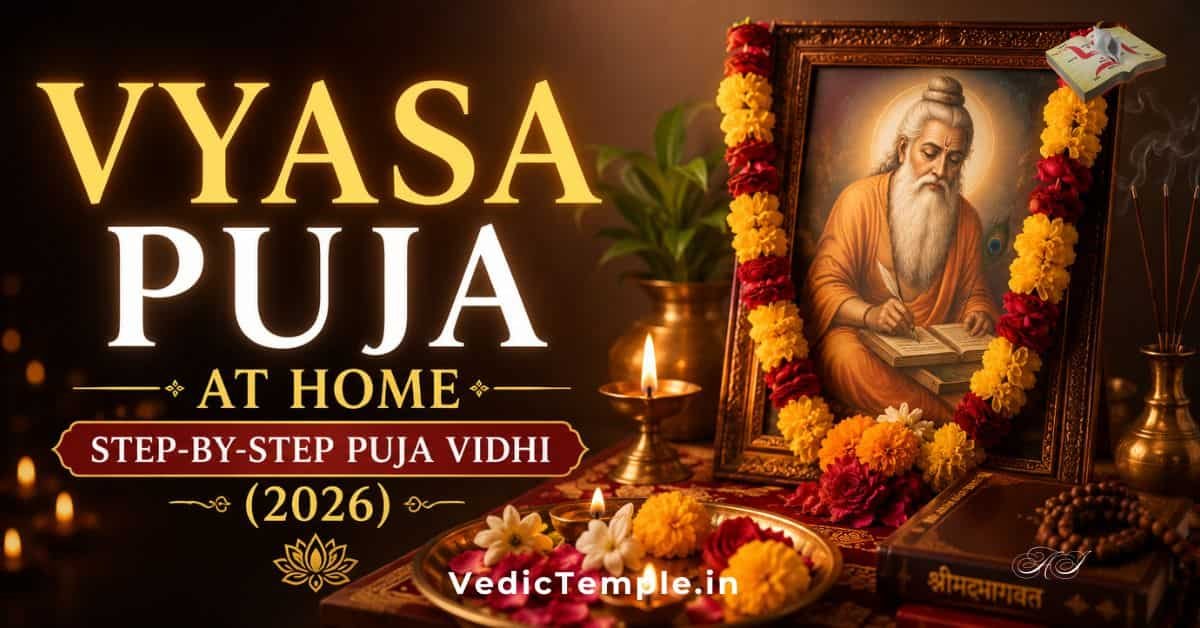
Vyasa Puja at Home: A Complete Step-by-Step Guide
Vyasa Puja is the ritual worship of Maharishi Ved Vyasa, performed at home or at a guru's ashram on Ashadha Purnima — the same full-moon day celebrated across India as Guru Purnima. The puja centers on setting up a symbolic seat for Vyasa, called the Vyaspeeth, invoking his lineage of teachers, and formally offering gratitude to one's own guru. In 2026, Vyasa Puja falls on Wednesday, 29 July, with the Purnima tithi running from 6:18 PM on 28 July to 8:05 PM on 29 July. This guide covers what you need, who is worshipped, and a complete step-by-step vidhi for performing the puja at home, along with a simplified version for anyone short on space, time, or ritual items.
When Is Vyasa Puja in 2026?
Vyasa Puja is fixed to the Purnima (full moon) tithi of the lunar month of Ashadha, so it falls on a different Gregorian date each year. Because the tithi is calculated the same way across India, the observance date does not vary by region.
|
Event |
Date / Time (IST) |
|
Vyasa Puja / Guru Purnima 2026 |
Wednesday, 29 July 2026 |
|
Purnima Tithi begins |
6:18 PM, 28 July 2026 |
|
Purnima Tithi ends |
8:05 PM, 29 July 2026 |
Because the tithi is active through sunrise on 29 July, Wednesday is the correct day for the puja, the vow, and any fasting associated with it.
Who Was Ved Vyasa, and Why Does He Get a Puja?
Hindu tradition holds that Maharishi Ved Vyasa was born on Ashadha Purnima, the son of the sage Parashara and Satyavati. Originally named Krishna Dvaipayana, he is remembered as the Adi Guru — the first teacher of humankind — because he organized the existing Vedic knowledge into the four Vedas, composed the eighteen Puranas, and authored the Mahabharata. Because nearly every later teacher in the Hindu tradition traces their line of learning back to him in some way, disciples worship him, or their own guru as his representative, on his birth anniversary.
Why Vyasa Puja Is Performed at Home
Not everyone can travel to an ashram or temple on Guru Purnima, so home worship of Vyasa and one's guru is a long-accepted alternative. The practice rests on a simple idea found in a well-known Sanskrit verse recited on this day: the guru is likened to Brahma, Vishnu, and Maheshwara — the remover of ignorance who deserves the same reverence as the divine. Performing Vyasa Puja at home is a way of formally acknowledging that debt: to Ved Vyasa as the source of Vedic knowledge, to one's own teachers, and often to parents as a person's first guides.
Vyasa Puja Samagri: What You'll Need
The full traditional puja uses a long list of items for the sixteen-step worship (shodashopchar), but most households keep a simpler set on hand. A practical list to gather beforehand:
- A clean white cloth to lay on the floor for the Vyaspeeth
- Ashtagandha or sandalwood paste (or turmeric/kumkum as a substitute) to draw the ritual lines
- A low wooden plank or seat (peeta), if available
- A picture, idol, or printed image of Ved Vyasa and/or your own guru — a plain photo is acceptable if nothing else is available
- Flowers, akshata (unbroken rice mixed with turmeric), and a few pieces of fruit
- Incense sticks and a lit lamp (diya)
- Water in a small vessel, and a spoon for offering it
- A new piece of cloth or thread, if you plan to offer one
- Sweets or a simple home-cooked dish to offer as naivedya (food offering)
The sixteen offerings of shodashopchar puja generally move through inviting the deity, offering a seat, water for the feet and hands, a symbolic bath, fresh cloth, sandalwood paste, flowers, incense, a lamp, food, betel leaf and areca nut, a token coin, and a closing circumambulation or aarti — the exact sequence and item names vary slightly between regional and sampradaya traditions, so it's fine to follow whatever version your family or guru lineage already uses.
Step-by-Step Vyasa Puja Vidhi at Home
1. Prepare yourself and the space
Wake up early, clean the room you'll use, bathe, and put on clean clothes. Many households observe a fast until the puja and any guru-darshan is complete.
2. Set up the Vyaspeeth (seat of Vyasa)
Spread the white cloth on the floor. Using ashtagandha paste, draw twelve lines on it — running north to south and east to west — to form the symbolic seat. Place the wooden peeta or a cushion on top if you have one.
3. Take the sankalp (vow)
Sit facing the Vyaspeeth and state your intention to perform the puja, traditionally by reciting a sankalp mantra to the effect of "I worship Guru Maharishi Ved Vyasa to honor and establish the guru lineage." Transliterations of this line vary by source and region, so it's fine to say it in your own words if you don't have the exact Sanskrit.
4. Invoke the guru lineage
On the seat, invoke Lord Brahma, the Supreme Energy (Paratparashakti), Vyasa, and the teachers who followed him — commonly named as Shukdev, Gaudapada, Govindaswami, and Adi Shankaracharya. If your own family or spiritual lineage venerates a different chain of teachers, invoke that lineage instead.
5. Perform the shodashopchar puja
Offer the sixteen items in sequence — water, a seat, flowers, incense, a lamp, food, and the rest — using whichever version of the sequence you're following. If you don't have all sixteen items, offering water, flowers, incense, a lamp, and food with sincerity is considered sufficient.
6. Honor your own guru and parents
After worshipping the Vyasa lineage, offer prayers and gratitude to your own diksha guru (the teacher who initiated or taught you) and to your parents, who are traditionally regarded as a person's first gurus. If your guru is alive, this is also the day many disciples visit, call, or send a message of gratitude and guru dakshina.
7. Read or recite scripture
It's traditional to read a portion of the Vedas, the Bhagavad Gita, or another text associated with Vyasa, and to renew a personal commitment to following your teacher's guidance.
8. Close with aarti and prasad
End the puja with an aarti, then distribute the food offering as prasad to family members.
Who Is Worshipped During Vyasa Puja? The Three Panchakams
A traditional Vyasa Puja invokes three groups of five teachers each, known as panchakams:
- Krishna Panchakam
- Vyasa Panchakam
- Shankaracharya Panchakam
Together these fifteen acharyas represent the broader teaching lineage that Vyasa is considered the head of. Some traditions extend this further — Gaudiya Vaishnava lineages, for instance, recognize seven panchakas in total, including groups devoted to Krishna, the four Kumaras, and the Panchatattva.
In the Gaudiya Vaishnava and ISKCON tradition specifically, "Vyasa Puja" more commonly refers to the annual worship of one's own spiritual master, who is honored as sitting on Vyasa's symbolic seat and representing him in an unbroken line of teachers going back to Krishna, Brahma, and Narada. Devotees in this tradition mark their guru's appearance day (birthday) as Vyasa Puja, offering homages, prasad, and an abhisheka ceremony rather than worshipping Ved Vyasa directly. If you follow this tradition, your Vyasa Puja may center on your own guru's appearance day rather than falling only on Ashadha Purnima.
A Simplified Vyasa Puja for a Small Home or Busy Schedule
The full vidhi above assumes floor space for a Vyaspeeth and a fairly complete set of items — not realistic for every household or apartment. A shorter version keeps the spirit of the day intact:
- Use a clean mat or small table instead of drawing lines with ashtagandha paste
- Place a photo of Ved Vyasa or your guru on it rather than an idol or peeta
- Offer a diya, incense, a flower, and a small food item
- Say the sankalp and a short prayer in your own words
- If your guru is living, a phone call, message, or video visit to express gratitude is considered a meaningful part of the observance even if you can't be there in person
What matters most in every version of this ritual, according to the tradition itself, is the sincerity of the gratitude being offered — not the scale of the setup.
Frequently Asked Questions
Is Vyasa Puja the same as Guru Purnima?
They fall on the same day and are closely related, but the terms are used slightly differently. Guru Purnima is the general festival honoring all teachers, observed by Hindus, Buddhists, and Jains. Vyasa Puja specifically refers to the worship of Maharishi Ved Vyasa (or, in Gaudiya Vaishnava tradition, of one's own guru as his representative) and is the term more commonly used within disciple communities that follow a specific guru lineage.
What is a Vyaspeeth, and do I need special materials to make one?
A Vyaspeeth is the symbolic seat prepared for Vyasa during the puja — traditionally a white cloth marked with twelve ashtagandha lines, topped with a low wooden seat. If you don't have ashtagandha powder or a wooden peeta, a clean cloth or mat with a photo placed on it is an accepted substitute; the seat is a focal point for the ritual, not a requirement with only one correct form.
Can Vyasa Puja be performed without a guru or priest present?
Yes. Vyasa Puja is commonly performed by individuals or families at home without a priest. If you have a living guru, the day is also an occasion to visit or contact them directly, but the home puja to Vyasa and the guru lineage can be done independently of that.
What if I don't have all the items for shodashopchar puja?
A partial offering — water, flowers, incense, a lamp, and a food offering — made with sincerity is considered acceptable. The sixteen-item sequence is the traditional complete form, not a strict minimum.
Which mantra is recited for the sankalp on Vyasa Puja?
The vow is traditionally recited in Sanskrit to the effect of dedicating the worship to Ved Vyasa in order to honor the guru lineage. Exact transliterations differ slightly between regional sources, so many households recite it in their own words or in whatever version their family or lineage already follows.
Vyasa Puja at home doesn't require a temple, a priest, or an elaborate setup — it requires setting aside time on Ashadha Purnima to acknowledge the teachers, living and historical, who shaped your understanding. Whether you follow the complete shodashopchar vidhi or a five-minute version with a photo and a diya, the day's purpose stays the same: a formal pause to say thank you to your guru.