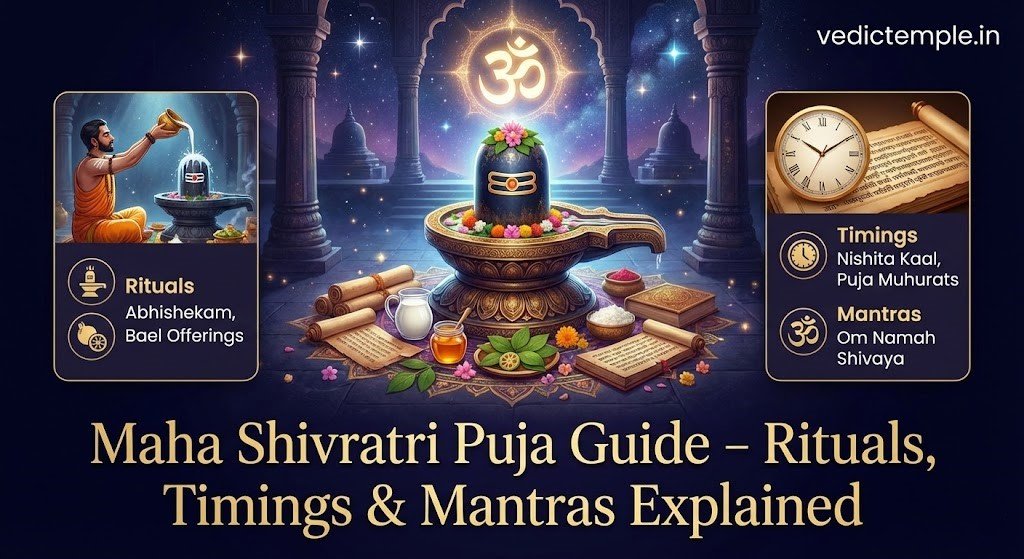
Om Namah Shivaya.
The most powerful night of the spiritual calendar is approaching. On Sunday, February 15, 2026, the world will celebrate Maha Shivratri.
Unlike other festivals that celebrate the defeat of a demon or the birth of an avatar, Maha Shivratri celebrates the convergence of Shiva and Shakti. It is the night of stillness, the night of the void, and the night of immense possibility.
For a devotee, this is not just a date on the calendar; it is an opportunity to wash away lifetimes of karma. However, to truly tap into the energy of this cosmic event, one must perform the Puja (worship) with the correct Vidhi (procedure) and Bhav (emotion).
Whether you plan to visit a temple or perform the ritual in the quiet corner of your home, this guide will walk you through everything you need to know to make your Maha Shivratri 2026 profound and spiritually rewarding.
Important Timings for Maha Shivratri 2026
Timing is everything in Vedic rituals. The energy of Shiva is present throughout the day, but it peaks during specific windows known as Muhurats.
The Date and Tithi
-
Festival Date: Sunday, February 15, 2026.
-
Chaturdashi Tithi Begins: February 14, 10:45 PM (IST).
-
Chaturdashi Tithi Ends: February 15, 11:10 PM (IST).
Nishita Kaal: The Midnight Hour The most auspicious time to perform the Shiva Puja is the Nishita Kaal. This is the midnight window when Lord Shiva appeared in the form of the Lingodbhava (Column of Fire).
-
Time: 12:09 AM to 01:01 AM (Early morning of Feb 16).
-
Significance: If you can only perform one puja, do it during this time. The veil between the material world and the spiritual world is thinnest here.
Parana Time (Breaking the Fast)
-
Time: After sunrise on February 16 (Monday), between 06:57 AM and 03:25 PM.
Essential Puja Samagri (Ingredients)
Shiva is Bholenath—the Simple One. He does not demand gold or silk. He is pleased with the wildest, simplest offerings of nature. Before you begin, gather these items:
-
The Deity: A Shivling (made of stone, metal, or mercury) or a picture of Lord Shiva.
-
Liquids for Abhishekam: Water (Gangajal if possible), Raw Milk (unboiled), Curd (Yogurt), Honey, Ghee, and Sugar/Jaggery.
-
The Leaves: Bilva Patra (Bel Leaves) is the most critical item. Ensure the leaves have three leaflets intact.
-
Flowers: White flowers (like Dhatura, Akanda, or Jasmine). Avoid Ketaki flowers (cursed by Shiva).
-
Other Items: Vibhuti (Holy Ash), Sandalwood paste (Chandan), Rudraksha beads, Incense, Camphor, and Fruits (Ber/Jujube is preferred).
Step-by-Step Puja Vidhi
Follow this procedure to perform a complete Rudra Abhishekam at home.
Step 1: Sankalp (The Vow) Sit facing East or North. Take some water, rice, and a flower in your right hand. Close your eyes and chant your name, location, and intent: "I, [Your Name], am performing this Maha Shivratri Puja to seek the blessings of Lord Shiva for peace, health, and spiritual growth. May my devotion be accepted." Drop the water on the ground.
Step 2: Dhyana (Meditation) Close your eyes and visualize Lord Shiva. You can visualize him as the meditative ascetic on Mount Kailash or as the symbolic Lingam. Calm your mind.
Step 3: The Abhishekam (The Holy Bath) This is the most important part of the ritual. Place the Shivling on a plate or a Jalahari. Pour the liquids slowly while chanting Om Namah Shivaya.
-
Water: Wash the Lingam to purify it.
-
Milk: Pour raw milk (symbolizing purity and nourishment).
-
Curd: Pour yogurt (symbolizing prosperity and progeny).
-
Honey: Pour honey (symbolizing sweet speech and removing sorrow).
-
Ghee: Pour ghee (symbolizing victory and moksha).
-
Water: Finally, wash everything off thoroughly with water so the Lingam is clean.
Step 4: Alankaram (Decoration)
-
Wipe the Shivling dry with a clean cloth.
-
Apply three horizontal lines of Vibhuti (Ash) or Chandan (Sandalwood) on the Lingam (Tripundra).
-
Place the Bilva Patra on top. The smooth side of the leaf should touch the Lingam.
-
Offer the Dhatura or white flowers.
-
Place a Rudraksha mala if you have one.
Step 5: Dhoop, Deep & Naivedyam
-
Light the incense sticks (Dhoop) and wave them around the deity.
-
Light the Ghee Lamp (Deep) and place it to the right of the Shivling.
-
Offer fruits or sweets (Naivedyam) to the Lord.
Step 6: Mantra Japa & Aarti Sit quietly and chant the mantras (listed below) for 10-15 minutes. Finally, stand up and perform the Shiva Aarti using camphor.
Powerful Mantras for Maha Shivratri
Sound is the form of Shiva (Nada Brahma). Chanting on this night creates a vibration that clears negativity from your aura.
The Panchakshari Mantra.
"Om Namah Shivaya"
-
Meaning: I bow to Shiva.
-
Usage: Chant this continuously during the Abhishekam. It balances the five elements in your body.
The Mahamrityunjaya Mantra.
"Om Tryambakam Yajamahe Sugandhim Pushti-Vardhanam Urvarukamiva Bandhanan Mrityor Mukshiya Maamritat"
-
Meaning: We worship the Three-Eyed One (Shiva), who is fragrant and nourishes all beings. May He liberate us from death for the sake of immortality, just as a ripe cucumber is severed from its bondage (the vine).
-
Usage: Chant this for health, longevity, and protection from accidents.
The Rudra Gayatri Mantra.
"Om Tatpurushaya Vidmahe Mahadevaya Dhimahi Tanno Rudrah Prachodayat"
-
Meaning: Let me meditate on the great Purusha, Oh, Mahadeva, give me higher intellect, and let Lord Rudra illuminate my mind.
Fasting Rules (Vrat Vidhi)
Fasting detoxifies the body and keeps sleepiness away, allowing you to stay awake for the night vigil (Jagaran).
Types of Fasting
-
Nirjala Vrat: The strictest form where no food or water is consumed for 24 hours. Recommended only for healthy individuals.
-
Phalahar Vrat: You can consume fruits, milk, and water. Rock salt (Sendha Namak) can be used, but avoid grains, rice, wheat, and pulses.
Guidelines.
-
Maintain celibacy (Brahmacharya) on the day of Shivratri.
-
Avoid negative thoughts, anger, and lying.
-
Break the fast only the next morning (Feb 16) after a bath and a simple puja.
The Science of Jagaran (Staying Awake)
You will hear elders say, "Do not sleep tonight." This is not a superstition; it is based on the yogic physiology.
On the night of Maha Shivratri, there is a natural upsurge of energy in the northern hemisphere. If you keep your spine vertical (upright) and stay awake, this energy can easily move up your spinal column, activating your chakras. Sleeping (horizontal position) hinders this flow.
If you cannot stay awake the whole night, try to stay awake at least until the Nishita Kaal (1:00 AM). Meditate, listen to devotional songs, or read spiritual texts to keep the mind engaged.
Conclusion: A Night of Transformation
Maha Shivratri 2026 is an open door. Lord Shiva is known as Ashutosh—the one who is easily pleased. You do not need complex rituals if your heart is pure. Even a single Bilva leaf offered with devotion is enough to earn his grace.
This February 15, use the guide above not just to perform a ritual, but to connect with the source of your existence. Let the Abhishekam wash away your ego, let the fasting cleanse your body, and let the Mantras purify your soul.
Har Har Mahadev!
Need Puja Samagri or Live Darshan?
-
Can't find Bilva leaves?
-
Want to book a Rudrabhishek at Kashi Vishwanath?
-
Looking for an authentic Rudraksha?
Visit VedicTemple.in for:
-
Complete Shivratri Puja Kits delivered to your door.
-
Online Puja Booking for Feb 15.
-
Live Streaming of the Great Night Puja.
May Lord Shiva bless you with eternal peace.