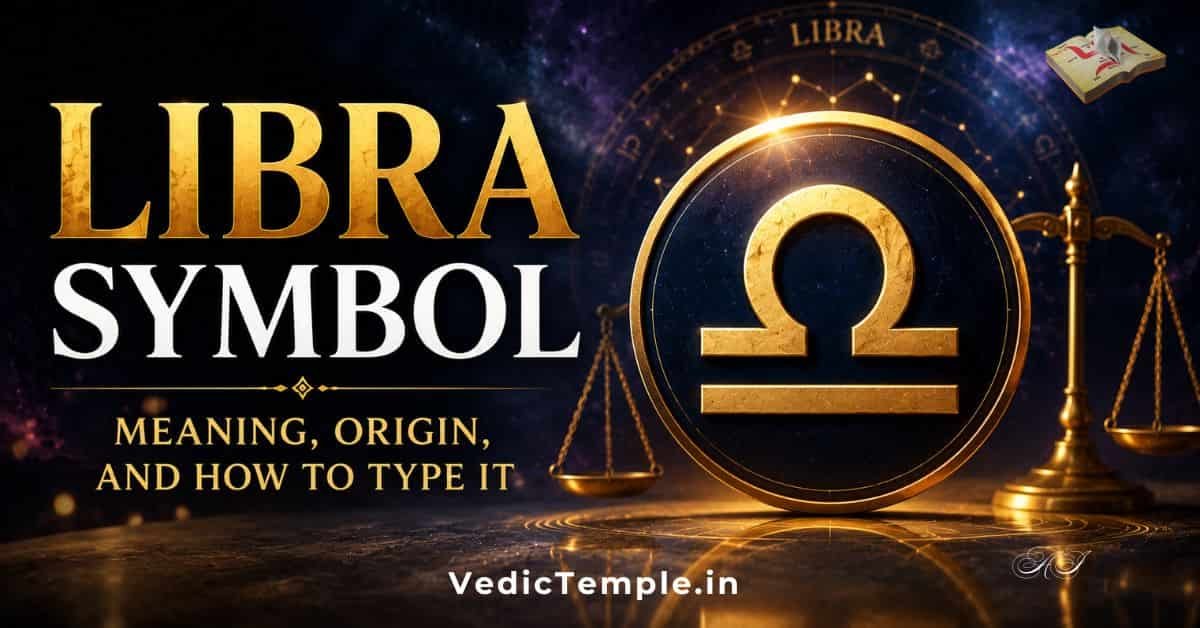
The Libra symbol is the scales (♎), representing balance, justice, and fairness. It's the only zodiac symbol that depicts an object rather than a person or animal, and its glyph — Ω with a horizontal line beneath it — is read either as a set of hanging scales or as the sun sitting on the horizon at the autumn equinox, when Libra season begins.
Below is where the symbol came from, what its shape actually means, which figures and symbols are associated with it, and how to type or copy the ♎ character on any device.
What Is the Libra Symbol?
Libra (September 23–October 22) is the seventh sign of the zodiac and the only one represented by an inanimate object instead of an animal or person — every other sign, from the Ram to the Fish, is living. Its glyph, ♎, is meant to evoke a balance scale: two pans suspended in equilibrium, weighing one thing fairly against another.
That imagery lines up with the sign's core theme. Libra sits opposite Aries on the zodiac wheel and marks the point where the sun crosses the celestial equator each autumn, making day and night almost exactly equal in length. Ancient skywatchers linked that astronomical balance to ideas of judgment, fairness, and equilibrium — and the scales became the natural symbol for it.
The Meaning Behind the Scales
Beyond the literal image, the scales are used to describe how Libra is said to approach life: weighing options, comparing perspectives, and looking for a fair outcome before committing to a decision. Astrologers tie this to Libra's ruling planet, Venus, and its role as a Cardinal Air sign — a combination associated with diplomacy, aesthetic sensitivity, and a strong pull toward partnership and cooperation.
The same symbol is also used to describe Libra's less flattering side: a suspended, swinging scale doesn't settle easily, which is why indecisiveness is one of the traits most commonly attached to the sign in popular astrology.
Where the Libra Symbol Came From
The scales weren't invented for the zodiac — they were adopted from older systems of judgment and adapted as astrology developed:
- Babylon: The earliest stargazers associated the stars now grouped as Libra with the scales used to weigh and judge the living and the dead.
- Egypt: A similar scale motif appears in Egyptian funerary tradition, where a person's heart was symbolically weighed against a feather to determine their fate in the afterlife.
- Greece: Greek astronomers originally folded these stars into the neighboring constellation Scorpius, seeing them as the scorpion's outstretched claws rather than a separate sign.
- Rome: Libra was formally separated into its own constellation and zodiac sign during the Roman era, when the scales were fixed as a symbol of law, balance, and civic order — the form that's carried through to modern astrology.
In mythology, the scales are also linked to Themis, the Greek Titaness of divine law, and her daughter Astraea, goddess of justice — both are traditionally depicted holding a set of scales, the same image later popularized as "Lady Justice."
How to Read the Libra Glyph
The written glyph ♎ is a stylized version of the Greek letter Omega (Ω) sitting above a horizontal line. Two common readings exist side by side:
- Hanging scales: the curved shape as the suspended pans of a balance scale, tilted level to show equilibrium.
- The setting or rising sun: the same curve as the sun resting on the horizon line — read as a sunset (an ending) when Libra begins in the Northern Hemisphere's autumn, or a sunrise (a beginning) in the Southern Hemisphere's spring.
Both readings point to the same idea: a moment exactly balanced between two states — day and night, one side and the other.
Symbols Associated with Libra
Because Libra is the only sign without a living emblem, several other figures and symbols have become loosely associated with it over time:
|
Symbol |
Association with Libra |
|
Scales |
The primary and official zodiac symbol; represents balance, fairness, and justice. |
|
Lady Justice |
A blindfolded figure holding scales and a sword — the blindfold reflects Libra's ideal of impartiality; the sword, its capacity for decisive judgment once a decision is made. |
|
Venus glyph |
Libra's ruling planet is Venus, drawn as a circle over a cross. It's a separate symbol from Libra's own glyph but frequently referenced alongside it in astrology content. |
|
Dove / Swan |
Informal associations tied to Venus, used in some astrology traditions to represent Libra's connection to beauty, harmony, and peace rather than an official zodiac emblem. |
How to Type or Copy the Libra Symbol (♎)
The Libra glyph has its own Unicode character, so it can be typed or copied directly on most devices without needing an image.
|
Format |
Code |
|
Character |
♎ |
|
Unicode |
U+264E |
|
HTML entity |
♎ (or ♎) |
|
Windows Alt code |
Hold Alt and type 9806 on the numeric keypad |
|
Mac shortcut |
Press Control + Command + Space to open Character Viewer, then search "Libra" |
|
Mobile / any device |
Copy the character ♎ directly from text and paste it wherever it's needed |
The symbol was formally included in the Unicode standard in 1993 (Unicode 1.1) and later added as a standalone emoji in 2015, which is why it now renders consistently across phones, apps, and browsers.
Frequently Asked Questions
What does the Libra symbol actually represent?
Balance and justice. It's read as a set of scales weighing two things evenly, tied to the autumn equinox when day and night are nearly equal in length.
Why is Libra the only zodiac sign with an object as its symbol?
Every other sign is represented by an animal or person (a ram, a bull, twins, a lion, and so on). Libra is the exception — its symbol reflects a concept, balance, rather than a creature.
Is the Libra symbol the same as the Libra constellation?
No. The glyph ♎ is the astrological symbol used in charts and writing; the constellation is the actual pattern of stars in the sky that the sign is named after. They're related but not identical.
What is the Libra glyph's Unicode character?
U+264E, which displays as ♎ and can be copied and pasted directly or typed using the HTML entity ♎.