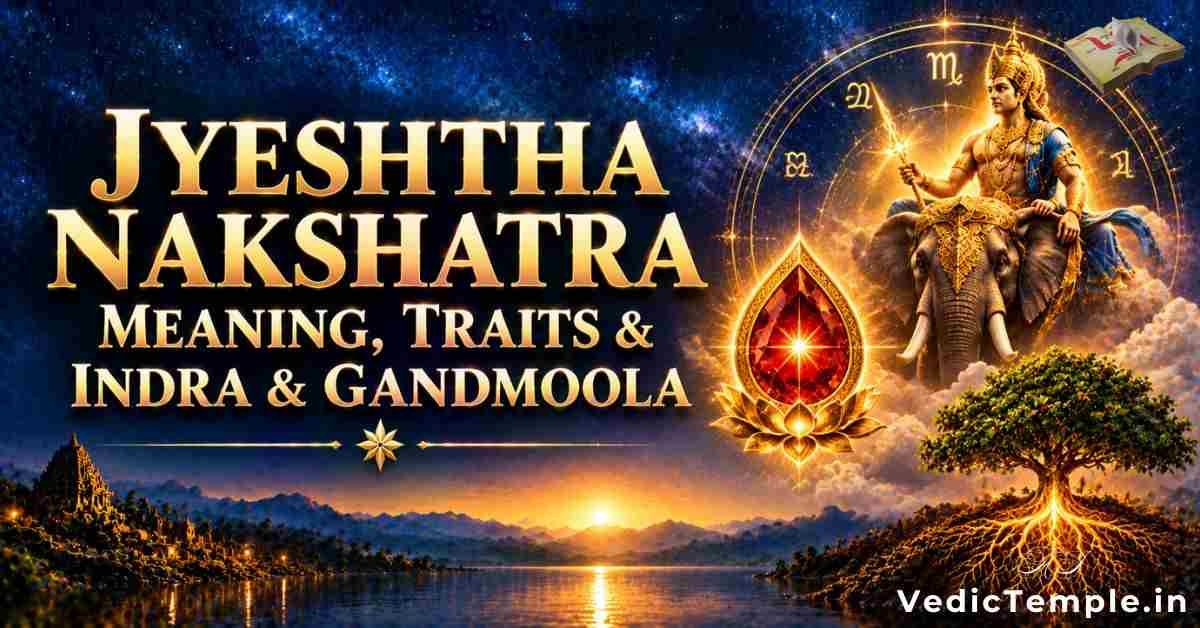
Jyeshtha Nakshatra: Meaning, Traits, Indra & Gandmoola
Jyeshtha is the 18th of the 27 nakshatras, occupying the final third of Scorpio (16°40′ to 30°00′). Its name means “the eldest” or “the most senior,” and that single word carries two quite different traditions at once: it describes Indra, the nakshatra’s presiding deity and king of the gods, as the first-born and foremost among them — and, separately, it is also the name of an actual goddess associated with misfortune. Ruled by Mercury, Jyeshtha is consistently described across sources as the nakshatra of seniority and authority, carrying real protective strength alongside a real cost: a tendency toward isolation, pride, and the kind of power that invites its own downfall.
Jyeshtha at a glance
|
Attribute |
Detail |
|
Span |
16°40′ – 30°00′ Scorpio |
|
Ruling planet (lord) |
Mercury |
|
Deity |
Indra, king of the gods |
|
Symbol |
A circular amulet, umbrella, or earring |
|
Gana |
Rakshasa |
|
Associated star |
Antares |
|
Special classification |
A Gandmoola nakshatra (see below) |
What the name means — in two different traditions
The most common reading ties “the eldest” directly to Indra: as king of the gods and, in some tellings, their first-born, Indra himself embodies seniority, so the nakshatra named for that quality carries his authority, strength and capacity to protect. A separate, less commonly discussed tradition identifies Jyeshtha as the name of an actual goddess — the elder sister and deliberate opposite of Lakshmi, goddess of fortune. This goddess Jyeshtha, also called Alakshmi or Moodevi in South India, personifies misfortune, poverty and discord, and is said to have emerged just before Lakshmi during the churning of the cosmic ocean. Both traditions are genuinely attested; which one a given source leans on tends to depend on whether it foregrounds Jyeshtha’s authority (the Indra reading) or its traditionally challenging reputation (the goddess reading) — and this nakshatra has a real claim to both.
The deity: Indra, and the weight that comes with his crown
Indra is the thunderbolt-wielding king of the gods, leader of the heavenly host, and the deity most associated with martial strength and sovereign authority. Several sources are explicit that Jyeshtha inherits not just Indra’s power but his well-known cautionary mythology: Indra’s own stories are full of hard-won status jeopardised by pride, jealousy, and an excessive attachment to rank. Read this way, Jyeshtha’s deity doesn’t just grant authority — it comes with a built-in warning about what tends to go wrong once that authority is secured.
The symbol: an earring, umbrella, or amulet
All three commonly cited symbols point to the same idea: a visible mark of rank. An umbrella, in particular, has a long-standing association with royal protection in Indian iconography — held over a king or deity as a literal canopy of shelter. An earring or amulet carries the same meaning in miniature: a worn sign of status and protection rather than a weapon. Taken together, the symbol describes Jyeshtha’s core theme precisely: visible seniority, and the responsibility to shelter others that’s expected to come with it.
Personality traits
Sources consistently describe Jyeshtha natives as naturally authoritative, strong-minded, and protective — the person who ends up in charge of the family, the team, or the room, often without having campaigned for the position. A genuine instinct to shelter and provide for people who depend on them is widely cited, alongside real strategic skill and the ability to operate effectively in situations that call for cunning as much as force. The recurring caution, mirroring Indra’s own mythology, is pride: several sources note a real risk of becoming possessive of status, jealous of rivals, or isolated at the top — the “eldest” standing protectively over others while also standing somewhat apart from them.
Career and professional tendencies
- Leadership and management roles, especially ones involving protecting or providing for a group
- Strategy, defence, security, and any field that rewards operating under pressure with real authority
- Research into hidden, complex or Scorpio-adjacent subjects, reflecting Mercury’s analytical mind paired with the sign’s depth
- Any senior advisory or protective role — the person others defer to and lean on in a crisis
Jyeshtha and Gandmoola
Jyeshtha is one of six Gandmoola nakshatras — the three that close out a water sign (Jyeshtha ending Scorpio, Ashlesha ending Cancer, Revati ending Pisces) and the three that open a fire sign immediately after (Mula opening Sagittarius, Ashwini opening Aries, Magha opening Leo). A child born with the Moon in Jyeshtha, particularly its final stretch, is traditionally given a Gandmoola Shanti ritual shortly after birth — the same common, traditional practice described in detail on our Ashlesha nakshatra page. It is not a sign of anything being wrong with the child, and is worth discussing with a family priest or astrologer rather than treating any single online description as the final word.
The four padas
Jyeshtha’s four padas each span 3°20′ and fall entirely within Scorpio, so the sign’s depth and intensity run through all four; the shift across padas is generally read as a matter of navamsa-sign nuance within that shared theme rather than a change in core character.
Frequently asked questions
What does Jyeshtha mean?
“The eldest” or “the most senior.” The name is usually read through Indra, king of the gods and foremost among them, though it’s also the name of a separate Hindu goddess associated with misfortune.
Which planet rules Jyeshtha nakshatra?
Mercury is the ruling planet (nakshatra lord) of Jyeshtha.
Who is the deity of Jyeshtha nakshatra?
Indra, king of the gods — the deity most associated with martial strength, leadership, and the authority (and the pride that can come with it) of holding the highest rank.
Is Jyeshtha also a goddess?
Yes, separately — Jyeshtha (also called Alakshmi or Moodevi in South India) is a goddess associated with misfortune, traditionally described as the elder sister and opposite of Lakshmi, goddess of fortune. This is a distinct tradition from the Indra-focused reading of the nakshatra’s meaning, though both are well attested.
Is Jyeshtha a Gandmoola nakshatra?
Yes — it is one of six nakshatras sitting at a sign-element junction (here, the close of Scorpio, a water sign, right before Mula opens Sagittarius, a fire sign). A child born there, especially in its final stretch, traditionally receives a Gandmoola Shanti ritual shortly after birth — a common practice, not a cause for concern.
What is the symbol of Jyeshtha nakshatra?
A circular amulet, umbrella, or earring — all readings of the same underlying idea: a visible mark of rank and protection.