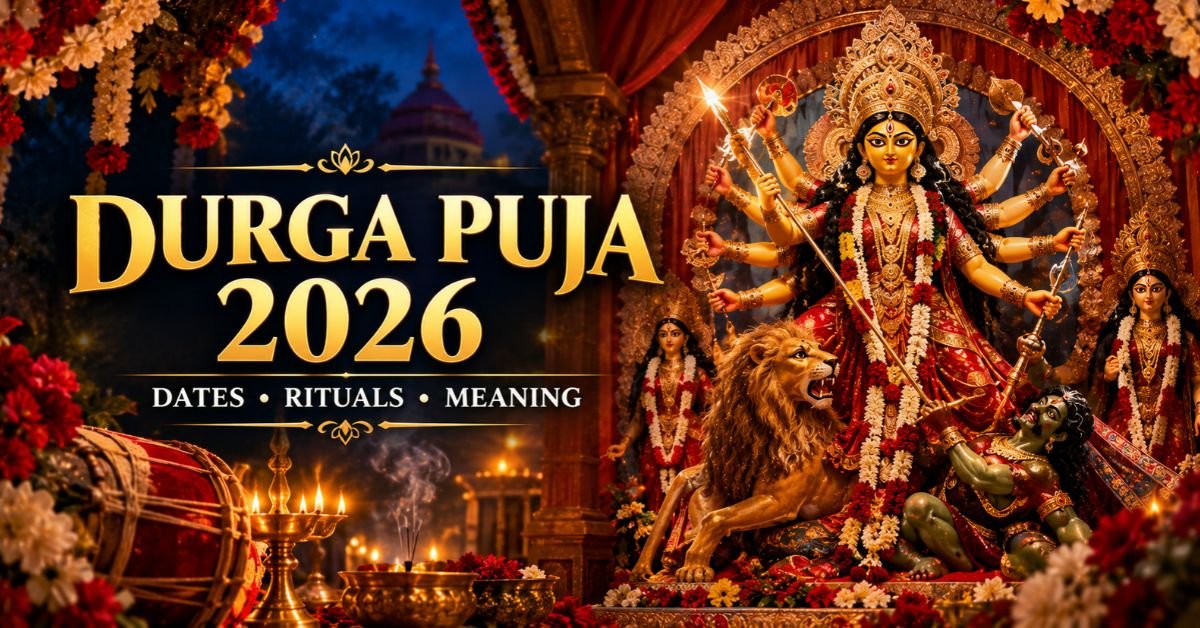
Durga Puja 2026: Dates, Rituals, Meaning & Celebration Guide
Durga Puja is a ten-day Hindu festival honouring the goddess Durga, celebrated with particular grandeur in West Bengal, Odisha, Assam, Tripura, Jharkhand and Bangladesh, and increasingly wherever large Bengali and wider Indian communities live, including cities across the US and UK. At its centre is the story of Durga defeating the shape-shifting buffalo demon Mahishasura, read as the triumph of good over evil. The main celebrations run across the last five days of the festival, from Shashthi to Vijaya Dashami, when the goddess is worshipped as a guest returning to her parental home before her idol is ceremonially immersed in water.
Durga Puja 2026 dates
The festival follows the Hindu lunisolar calendar, so its Gregorian dates shift every year. In 2026, the main days fall as follows:
|
Day |
Date (2026) |
Significance |
|
Mahalaya |
Saturday, 10 October |
Marks the end of Pitri Paksha and the start of Devi Paksha; invokes the goddess’s arrival |
|
Maha Panchami |
Friday, 16 October |
Final preparations; idols are dressed and decorated |
|
Maha Shashthi |
Saturday, 17 October |
Bodhon: the goddess is formally invoked and her face unveiled |
|
Maha Saptami |
Sunday, 18 October |
Nabapatrika ritual; main worship begins |
|
Maha Ashtami |
Monday, 19 October |
Widely considered the most significant day: Kumari Puja, Pushpanjali, and Sandhi Puja at the Ashtami–Navami junction |
|
Maha Navami |
Tuesday, 20 October |
Homa (fire ritual) and Maha Bhog offerings |
|
Vijaya Dashami |
Wednesday, 21 October |
Visarjan (idol immersion) and Sindoor Khela; the goddess’s symbolic departure |
Sandhi Puja is timed to the precise astrological junction between the Ashtami and Navami tithis — the last 24 minutes of one and the first 24 minutes of the next, a window of about 48 minutes in total. The exact clock time depends on your city and on which panchang is used, and different sources can quote slightly different windows for the same date, so check a panchang local to where you are rather than relying on a single quoted time.
The story behind the festival
The central narrative, told in the Devi Mahatmya section of the Markandeya Purana, describes the demon Mahishasura, who had become powerful enough to defeat even the gods because no man could kill him. In response, the gods combined their collective energies to create Durga, a goddess whose power exceeded any single deity’s. Riding a lion and wielding weapons gifted by the gods, she fought Mahishasura for nine days and nights before finally defeating him on the tenth, a victory still commemorated as Vijaya Dashami, or Dussehra in other regional traditions.
What Durga Puja means
Beyond the mythology, the festival carries several layers of meaning. It is read as the triumph of righteousness over destructive force, and, because the central figure is a goddess, it is also widely read as a celebration of feminine divine power, or Shakti. Socially, the ten days function as one of the largest annual gatherings of community life in eastern India: temporary pandals (ornately decorated marquees housing the idol) double as public art installations, neighbourhoods compete on craftsmanship and theme, and the festival has become, alongside its religious core, a major cultural and creative economy event.
In December 2021, “Durga Puja in Kolkata” was inscribed on UNESCO’s Representative List of the Intangible Cultural Heritage of Humanity, the first festival from Asia to receive the designation. The inscription recognised the festival specifically as practised in Kolkata, citing it as a large-scale public performance of religion and art and a space that brings together craftsmen, designers and artists across class and community lines.
Day-by-day: the main rituals
Mahalaya
The day before the festival proper begins, marking the transition from Pitri Paksha (a fortnight honouring ancestors) to Devi Paksha (the fortnight of the goddess). In Bengali households, this is traditionally marked by Chandipath, verses recounting the goddess’s glory, broadcast on radio and television before sunrise.
Shashthi (Bodhon)
The goddess’s face is ceremonially unveiled and she is formally invoked into the idol, a ritual called Bodhon. This is the day most pandals open to the public.
Saptami (Nabapatrika and Kola Bou)
Nine different plants, collectively called Nabapatrika, are bound together and bathed, representing nine forms of the goddess. The bundle is dressed in a sari and installed beside the main idol, popularly nicknamed Kola Bou (“banana-tree bride”) because the banana plant is the most visible of the nine. Main worship begins this day.
Ashtami (Kumari Puja, Pushpanjali, Sandhi Puja)
Widely held to be the most significant day of the festival. Pushpanjali, a flower offering, is made to the goddess by devotees. Kumari Puja, the ritual worship of a young pre-pubescent girl as a living embodiment of the goddess, is performed in many traditions, most famously at Belur Math. At the exact junction between Ashtami and Navami, Sandhi Puja is performed — a brief, intense ritual historically associated with the moment Durga is said to have slain the demons Chanda and Munda.
Navami
Homa (a fire offering) is performed, and Maha Bhog, an elaborate food offering, is made to the goddess before it is distributed as prasad to devotees.
Vijaya Dashami (Visarjan and Sindoor Khela)
The festival closes with Visarjan, the ceremonial immersion of the idol in a river, pond or the sea, symbolising the goddess’s return to her heavenly abode after her stay with her earthly family. Before immersion, married women traditionally take part in Sindoor Khela, applying vermillion to the idol and then to each other as a gesture of marital blessing. “Vijaya Dashami” literally means “the victorious tenth day”, marking the same mythological victory that other regional traditions mark as Dussehra.
Is Durga Puja the same as Navratri or Dussehra?
Related, but not identical, and this is one of the most common points of confusion. Navratri (“nine nights”) is observed across much of India over the same lunar fortnight, honouring nine forms of the goddess over nine nights, and culminates on the tenth day, Dussehra or Vijayadashami, which marks Durga’s victory over Mahishasura in the east and, in much of North India, Rama’s victory over Ravana instead. Durga Puja is the Bengali-tradition name for the same broad period, with its own distinct ritual calendar (Mahalaya, Bodhon, Nabapatrika, Sandhi Puja, Sindoor Khela) and its own emphasis on elaborately sculpted clay idols and public pandals rather than, for instance, Gujarat’s Garba and Dandiya dance traditions or North India’s Ramlila performances. All of these traditions are observed in roughly the same lunar window and honour the same goddess or the same mythological victory, but the specific rituals, regional names and cultural expression differ considerably.
Regional names for the same celebration
|
Name |
Region / community |
|
Durga Puja, Sharadiya Pujo, Akalbodhan |
West Bengal, Tripura, Assam, Jharkhand, Bangladesh |
|
Puja, Pujo |
Odisha and Bihar (used as a standalone term) |
|
Navratri / Dussehra |
Most of North, West and South India |
|
Dashain |
Nepal |
|
Bathukamma (a related but distinct festival) |
Telangana |
Durga Puja outside Bengal and in the diaspora
Durga Puja is celebrated well beyond West Bengal. Odisha, Assam, Tripura, Jharkhand and Bihar all have long-standing traditions of their own, and Bangladesh observes it as Sharadiya Durga Puja on a large scale across the country. Among the Indian and Bengali diaspora, community pujas are organised every year in cities across the US and UK, often condensed into the nearest weekend for a working diaspora calendar, with the full day-by-day ritual sequence, cultural performances, and festival food, run by local cultural associations and temples rather than neighbourhood pandals.
Frequently asked questions
What is Durga Puja and why is it celebrated?
Durga Puja is a Hindu festival celebrating the goddess Durga’s mythological victory over the demon Mahishasura, read as the triumph of good over evil. It is celebrated with particular prominence in West Bengal and neighbouring states, and by Bengali and wider Indian communities around the world.
Durga Puja kab hai 2026 mein? (When is Durga Puja in 2026?)
2026 mein Durga Puja ki mukhya puja Maha Shashthi se shuru hoti hai, 17 October ko, aur Vijaya Dashami, 21 October ko samapt hoti hai. Mahalaya, jisse tyohaar ka mahaul banta hai, 10 October ko hai.
How many days does Durga Puja last?
The core festival runs across ten days from Mahalaya to Vijaya Dashami, though the main public celebrations, when pandals are open and crowds gather, concentrate on the final five days, Shashthi through Dashami.
What is the difference between Durga Puja and Navratri?
They fall in the same lunar fortnight and honour the same goddess, but Navratri is the pan-Indian nine-night observance culminating in Dussehra, while Durga Puja is the specific Bengali-tradition festival with its own ritual calendar and its emphasis on elaborately crafted idols and public pandals.
What is Kumari Puja?
Kumari Puja is the ritual worship of a young pre-pubescent girl, chosen to represent a living embodiment of the goddess on Maha Ashtami. It is performed in several traditions, most famously at Belur Math near Kolkata, and reflects the festival’s broader theme of honouring feminine divine power.
Why is the idol immersed in water at the end?
Visarjan, the immersion, represents the goddess’s return to her heavenly abode after her symbolic stay with her earthly family during the festival, and is also read as a reminder of the cyclical, impermanent nature of form in Hindu thought.
Has Durga Puja received any international recognition?
Yes. In December 2021, UNESCO inscribed “Durga Puja in Kolkata” on its Representative List of the Intangible Cultural Heritage of Humanity, the first Asian festival to receive this status.
Is Durga Puja celebrated outside India?
Yes. Beyond Bangladesh, where it is a major national celebration, community Durga Pujas are organised every year across cities in the US and UK by local Bengali and Indian cultural associations, usually alongside the diaspora’s own practical adaptations, such as moving celebrations to the nearest weekend.